Some of the most coveted treasures in vintage card collecting can be found in 1948 Leaf Baseball rookie cards. It was the first post-World War II color baseball card set, and it captured several future Hall of Famers at the start of their big-league careers.
David Gonos of the Happy Hobby Newsletter put together a list of 11 cards from the 1948 Leaf set that he feels are the best. I picked my five favorites so we can talk about them in more detail.
Editor’s Note: The Sports Card Cash-Out System Guide is Now Available!
The Essential Five 1948 Leaf Baseball Rookie Cards
According to Gonos, these five rookie cards are among the group of must-have pieces of cardboard from the legendary 1948 Leaf release:
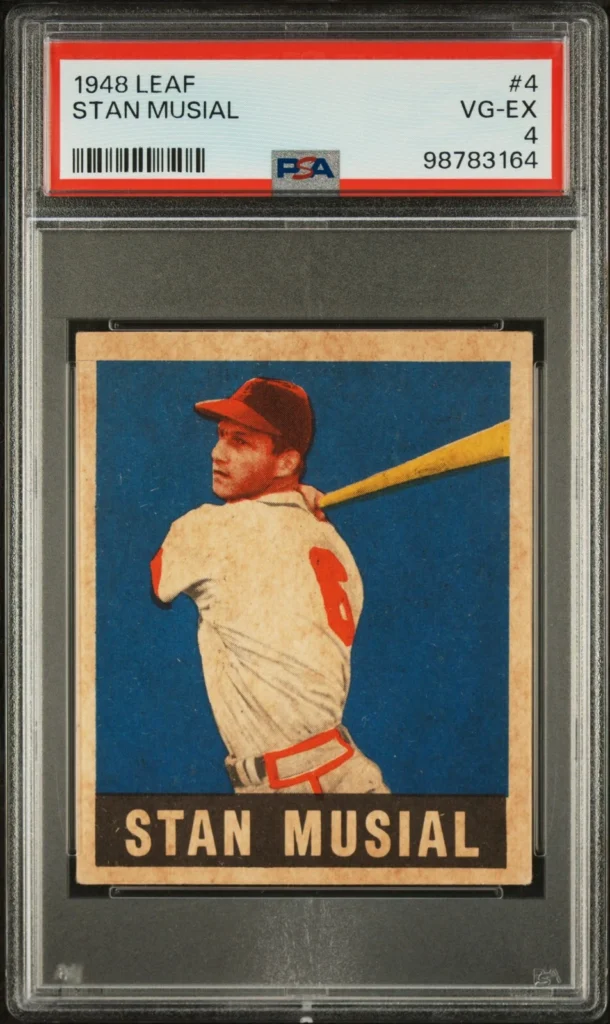
Stan Musial (#4): Stan the Man’s only recognized rookie card (along with 1948 Bowman) showcased a vibrant color photo that makes this one better to look at between the two.

Ted Kluszewski (#38): Big Klu’s debut card showcases a slugger who would become famous for cutting the sleeves off his uniforms.
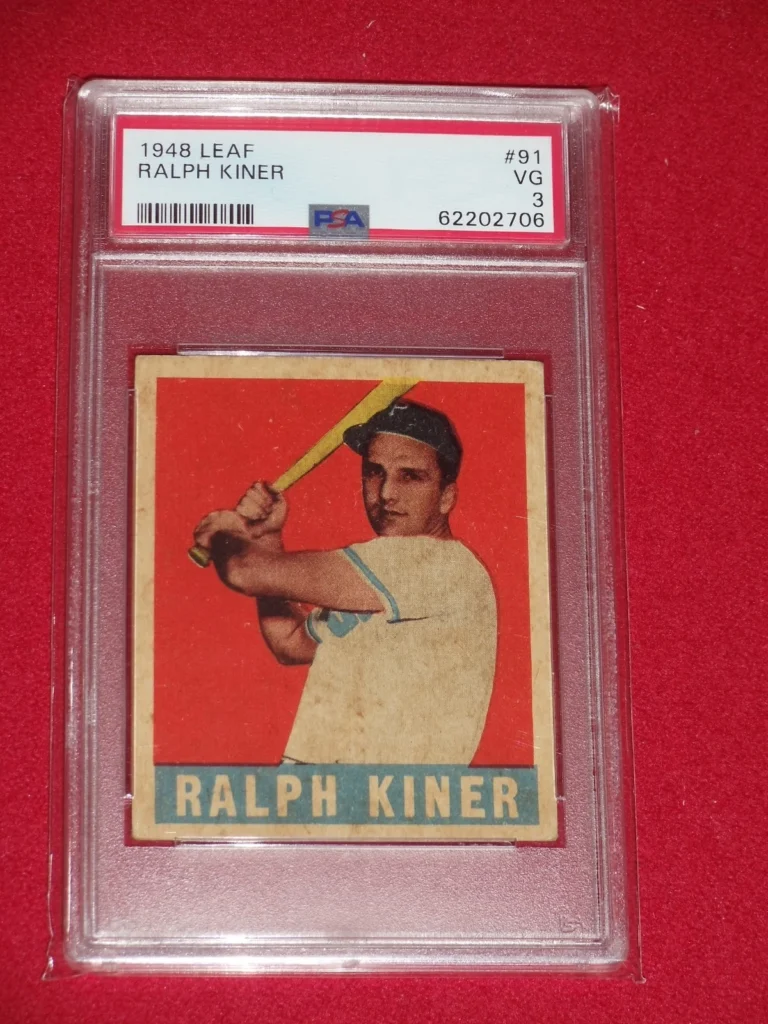
Ralph Kiner (#91): The Pittsburgh Pirates‘ single-season home run king captured amid his seven straight seasons of 35-plus homers.

Warren Spahn (#32): The Hall of Fame southpaw’s first major card appearance.

Jackie Robinson (#79): The barrier-breaking legend’s rookie card from his second season. It’s one of the most historically significant cards in the hobby.
Stan Musial: The Cardinals’ Crown Jewel
According to recent auction data from PSA, Musial’s 1948 Leaf card consistently outperforms the 1948 Bowman. Not just in visual appeal, but also in collector preference. Current market data shows PSA 4 examples selling in the $2,400-$2,500 range, with higher grades commanding much more.
What makes Musial’s career so remarkable? The legendary left-handed hitter finished with stats that read like every collector’s dream: 3,630 career hits (split perfectly between home and road games – 1,815 each), .331 batting average, 475 home runs (the most in Cardinals history), three MVP awards, and 24 All-Star Game selections.
His 1948 season was particularly eye-popping. He nearly won the Triple Crown, leading the National League with a .376 average and 131 RBI. Musial led the league in tons of other categories on his way to taking home his final MVP Award.
It’s his consistency that’s translated into lasting collectible value. He finished within the top 10 of MVP Award voting 13 times between 1942 and 1957, including nine top-five finishes.
Ted Kluszewski: The Sleeveless Slugger’s Debut
According to Sports Card Investor, PSA 6 examples of Kluszewski’s rookie are averaging around $300, with PSA 8 copies reaching the $1,500 range. That might seem modest compared to Musial, but we need to keep Big Klu’s impact during his prime years at the forefront of our minds.
From 1952-56, he was one of baseball’s most dangerous hitters, combining his signature power with a high batting average and strikeout numbers so low that many of today’s power hitters could do in a month what Kluszewski did in one year. A typical season for him during this stretch included a .316/.383/.571 line with 37 homers, 23 doubles, 110 RBI, 94 runs scored, and just 34 strikeouts.
His career numbers – .298 average, 279 home runs, and 1,028 RBI over 15 seasons – are the kind of production that’ll get the attention of vintage card collectors.
But honestly, what makes Kluszewski’s card special goes beyond the stats. This rookie card captures the beginning of a legend whose sleeveless uniform style became as iconic as his swing. But his reasoning behind it was more for function than anything else.
The Cincinnati Enquirer reported that Klu started cutting his sleeves because “every time I’d swing, it would get hung up on the sleeve.”
The 1948 Leaf Set’s Lasting Impact on Collecting
Leaf Baseball’s 1948 rookie cards helped revolutionize the hobby, but it’s hard to get your hands on them these days.
Nearly half the cards were short-printed, with only 98 total cards despite numbering that spans from 1 to 168. PSA research says this skip-numbering was likely done to keep getting people to buy packs. And while that was initially a marketing strategy, it now creates scarcity premiums for those hunting them today.
This set’s impact and legacy extend beyond individual card values. They established color photography as the standard for baseball cards and proved that collectors would pay premium prices for visual quality and player significance.
Love home runs? Sign up for my Substack today and start getting interesting home run-related observations straight to your inbox!