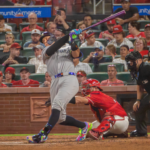
When it comes to the most home runs hit in a single season, the 60-homer club is what all MLB sluggers dream about joining.
Someone has hit 60-plus taters in one year just 10 times in MLB history. Since pro baseball dates back to 1871, this is one of the most exclusive clubs you’ll find.
Babe Ruth was the first to reach that plateau, hitting exactly 60 in 1927, and it took 34 years before anyone matched him. While Ruth and Roger Maris showed us it was possible, the 60-homer threshold had this mystical quality to it, with a fair share of players coming close, but not close enough, to making it happen.
Then came a four-year window from 1998 to 2001 that turned the baseball world upside down (in more ways than one). And then a long silence before two more occurrences in the 2020s.
Let’s dive into each season a player hit 60 or more homers, and more importantly, what made each of them different.
Related: A Complete Guide to Single-Season (& Single-Game) HR Performances
The 60-Home Run Club: Most Home Runs Hit in a Single Season
| Player | Year | HR Total | Team |
|---|---|---|---|
| Barry Bonds | 2001 | 73 | San Francisco Giants |
| Mark McGwire | 1998 | 70 | St. Louis Cardinals |
| Sammy Sosa | 1998 | 66 | Chicago Cubs |
| Mark McGwire | 1999 | 65 | St. Louis Cardinals |
| Sammy Sosa | 2001 | 64 | Chicago Cubs |
| Sammy Sosa | 1999 | 63 | Chicago Cubs |
| Aaron Judge | 2022 | 62 | New York Yankees |
| Roger Maris | 1961 | 61 | New York Yankees |
| Babe Ruth | 1927 | 60 | New York Yankees |
| Cal Raleigh | 2025 | 60 | Seattle Mariners |
As we can see from the above table, three players have punched their ticket into this club more than once, making an even more exclusive subset of this club. Sammy Sosa is the only one to accomplish the feat three times, and this group is full of primary outfielders other than Mark McGwire (first base) and Cal Raleigh (catcher).
The Steroid Era Cluster (1998–2001): 7 Seasons, 4 Years, 3 Players

There’s no honest way to talk about the 60-home run club without spending a fair amount of time here. From 1998-01, McGwire, Sosa, and Barry Bonds turned a threshold that had stood for 71 years into something that happened almost every season.
Let’s start with 1998, because that’s where the cultural earthquake hit. McGwire and Sosa spent the entire summer chasing Roger Maris’s 61-homer record in tandem. Baseball — still recovering from the 1994 strike — needed that kind of storyline. As a kid, I absolutely loved waking up each morning so I could turn SportsCenter on as quickly as possible to see who went deep the night before.
McGwire finished with 70. Sosa finished with 66. That’s 136 home runs between two players who were simultaneously chasing the same record in the same season. We had multiple players chasing 60 in the same year (Maris and Mickey Mantle in 1961 immediately comes to mind), but nothing remotely like this had ever happened before.
What’s worth digging into on McGwire’s 1998 season is that he was just as good in the second half as he was in the first. He slugged 37 homers with a 1.252 OPS across 81 first-half games, compared to another 32 homers with a 1.154 OPS in 74 games following the All-Star break. The only month he didn’t finish with double-digit homers was July, and he still slugged 8 during that period.
If you want to talk about consistency, though, look no further than Sosa’s first- and second-half splits. He slugged 33 homers before the All-Star break and mirrored that production after it. Slugging 20 homers in June certainly helped him get on a record-setting pace.
Then 1999 rolls around. Instead of a cooldown, McGwire and Sosa put on an incredible encore performance by slugging 65 and 63 homers, respectively. While the era in which they played had a role, it’s still impressive that they accomplished this feat in consecutive years…after it had happened just twice in history before them.
Sosa finished off his trifecta by hitting another 64 in 2001, which would’ve been the record in any other era. But he didn’t even lead the National League that season because a 36-year-old Barry Bonds broke all the records with 73 of his own. Ironically enough, this was the only time he finished a year with 50 or more homers. So, he definitely made it count.
It was the start of an insane four-year stretch for Bonds. His first of four straight National League MVP Award campaigns included those 73 homers, 137 RBI, 129 runs scored, and an eye-popping .328/.515/.863 triple slash.
The steroid cloud that hangs over this entire cluster is well-documented. What’s worth noting is that none of these seasons have been removed from the record books (as far as I know, there’s no asterisk, either). They’re all officially part of the history of this sport, complicated as that history may be.
The Bookends: Ruth, Maris, Judge, and Raleigh
The four seasons on this list that exist outside the steroid era cluster tell a different story. These are separated by nearly a century of baseball history, and each one arrived with its own unique weight.
Babe Ruth, 1927: 60 Home Runs
Ruth’s 1927 performance stood as the record for the most home runs hit in a single season for 34 years. The man was playing in a completely different offensive environment, facing pitching that was nowhere near as specialized as what modern hitters see, and he still put up a number that nobody could touch for over three decades.
His supporting stats that season were absurd even by today’s standards. He slashed .356/.486/.772 with those 60 homers, 165 RBI, and 158 runs scored in 151 games played. So, for those doing the math at home, the Great Bambino averaged more than one RBI and one run scored per game during this particular campaign. The 1927 Yankees are often called the greatest team ever assembled, and Ruth was the engine (along with Lou Gehrig).
What’s easy to forget is that 60 homers was genuinely unimaginable at the time. The second-highest total in baseball that year was accomplished by Gehrig, who hit 47 taters. But the guys in third place? That’d be Cy Williams and Hack Wilson, who both hit 30 homers.
Roger Maris, 1961: 61 Home Runs
The 34-year wait ended with Maris, but it didn’t come without its own kind of controversy. Baseball had expanded from eight teams to 10 that year in the American League, which meant more games (162 instead of 154) and, critics argued, diluted pitching. Commissioner Ford Frick, who had been a close friend of Ruth, ruled that the record would only be recognized as the true mark if it was set within 154 games. Maris hit his 61st on the final day of the season.
He also endured a brutal amount of public pressure while chasing the record. He lost hair in clumps from the stress and was booed in his home stadium. Maris hit 61 home runs in 1961 under conditions that would’ve broken most people, and he took home his second straight American League MVP Award for the Yankees.
Aaron Judge, 2022: 62 Home Runs

Aaron Judge put together possibly one of the most dominant contract years ever, and it was one of the most powerful displays we had seen in quite a while. Before Judge, the last player to come closest was Giancarlo Stanton, who slugged 59 in 2017 for the Miami Marlins.
These two got to their respective numbers in very different ways, though. Stanton had just two months of double-digit homers (July and August) — that stretch alone accounted for a jaw-dropping 30 homers.
Judge was much more consistent. Once he passed Maris, September/October became his fourth month with double-digit homers. His lowest total in a full month was six in April. From May through the end of the regular season, he didn’t finish a month with fewer than nine taters.
Cal Raleigh, 2025: 60 Home Runs
Cal Raleigh sticks out on this list because he’s the only catcher…and we’ve never seen a primary backstop produce the kind of prodigious power he provided for the Seattle Mariners in 2025.
His 38 homers before the All-Star break are second all-time to Barry Bonds (39 in 2001), but no catcher (switch-hitter or not) has hit more first-half taters than him. That was followed by becoming the first catcher to win the Home Run Derby. In addition to setting the single-season catcher home run record, he also gave us the most powerful season of all time for a switch-hitter after passing Mickey Mantle.
While Raleigh’s monthly OPS numbers rode a bit of a roller coaster, his power production was consistent. Big Dumper slugged at least 10 homers in a month four times. His two worst months were July and August, but he hit eight and nine homers, respectively, despite posting a slugging percentage below .500 in both months.
Frequently Asked Questions
What is the most home runs hit in a single season in MLB history?
How many players have hit 60 or more home runs in a season?
Has any catcher ever hit 60 home runs in a season?
Did any player hit 60 home runs more than once?
Love home runs? Sign up for the Bases Loaded Bulletin today to get the best home run content straight to your inbox! And if you’re new to MLB Daily Dingers, it’s probably best to start here.