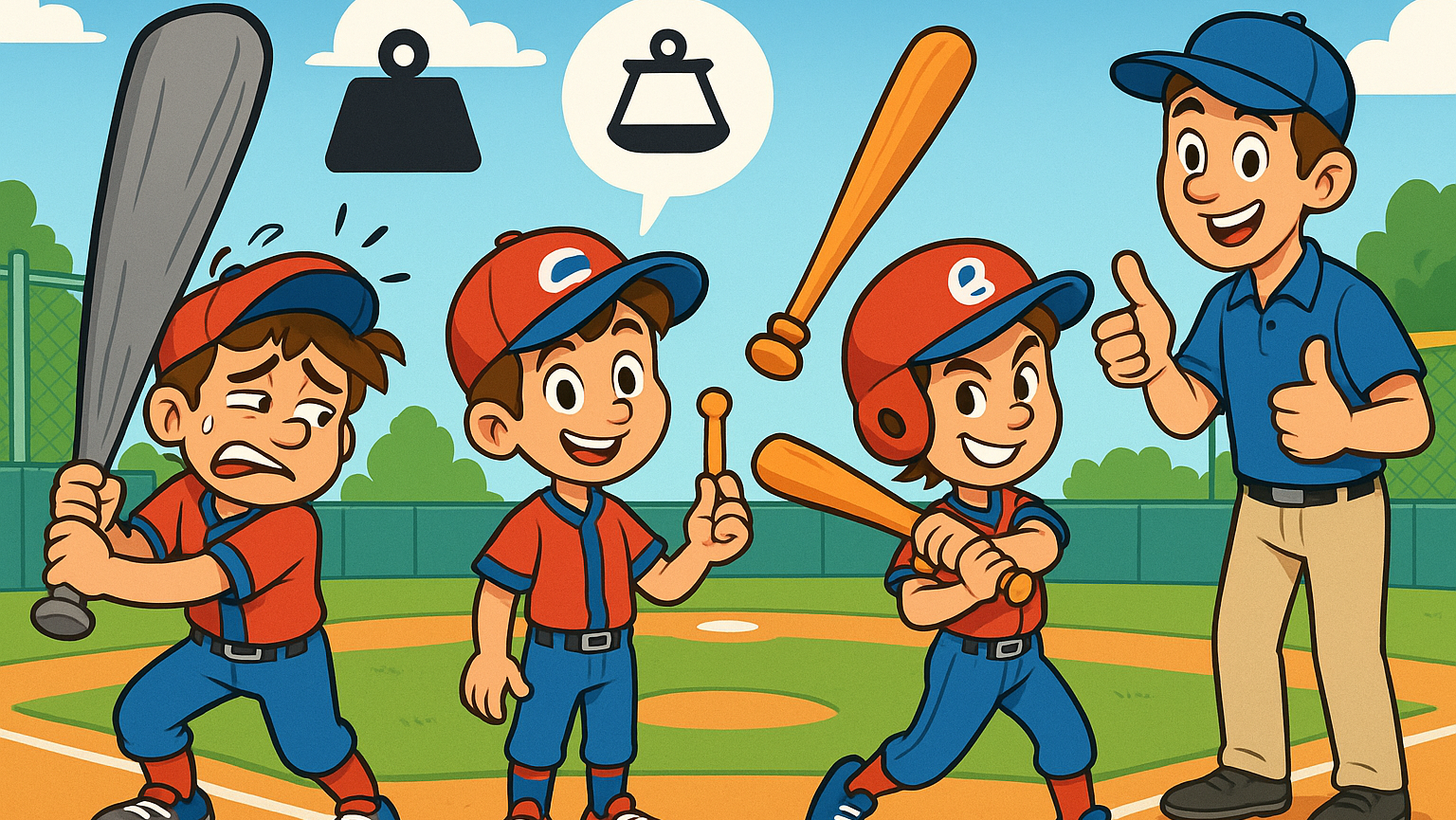
Every spring, thousands of well-meaning parents fall into the same trap, selecting bats based on what older kids use or what looks “cool” rather than understanding how baseball bat weight should match their child’s current strength and development. But when you nail the perfect baseball bat weight for your young slugger, the transformation is wonderful to watch.
Suddenly, those weak ground balls become line drives, confidence soars, and the pure joy of baseball takes center stage. We’ll the science and strategy behind matching bat weight to strength in this article.
READ MORE: BBCOR vs USSSA Bats: Complete Guide to Choosing The Right Bat
Why Bat Weight Matters More Than You Think
The relationship between bat weight and performance isn’t just important—it’s fundamental to your child’s development as a hitter. When a young player swings a bat that’s too heavy, their swing mechanics suffer. They compensate by dropping their hands, stepping out early, or developing a slow, choppy swing that becomes muscle memory.
Research from the Sports Science Institute shows that players swinging appropriately weighted bats generate 12-15% more bat speed than those using equipment that’s too heavy for them. That translates directly into better contact, increased distance, and more success at the plate.
But proper bat weight doesn’t just improve performance. It also prevents injury. Young arms and shoulders aren’t designed to repeatedly swing heavy objects at high speeds. When we match equipment to current ability rather than aspirational goals, we’re protecting a kid’s long-term health while maximizing their immediate enjoyment.

Assessing Your Player’s Current Strength Level
Before we talk numbers, let’s establish where your player stands right now. The beauty of strength assessment lies in how simple it is. You don’t need expensive equipment or professional testing to get accurate results.
Simple At-Home Tests That Work
Start with the one-handed bat hold test. Have your child grip the bat at the knob and extend it straight out from their body, parallel to the ground. Can they hold it steady for 10 seconds without significant trembling or dropping? If yes, they’re strong enough to control that weight during a swing. If they struggle, it’s time to go lighter.
Next, implement the swing endurance test. Set up 20 full-speed swings off a tee, paying attention to form and mechanics. Players should maintain consistent mechanics through all 20 swings. When form breaks down around swing 12-15, the bat might be too heavy.
Physical Development Markers
Chronological age tells only part of the story. Body type matters a lot, too. Tall, lanky players often need lighter bats to maintain swing speed, while shorter, stockier athletes might handle heavier options more effectively.
Reassess a few times per year (especially during rapid growth periods), seasonally before major competitions, and whenever performance indicators suggest a change might be needed.
How Baseball Bat Weight and Drop Numbers Work Together
Drop weight represents the mathematical relationship between bat length and weight. Subtract the weight in ounces from the length in inches, and you get the drop number. A 30-inch bat weighing 20 ounces has a -10 drop. This number becomes your roadmap for appropriate equipment selection.
Age-Based Starting Points That Actually Work
For ages 6-8, start with -12 to -13 drop weights. These ultra-light options allow developing players to focus on swing mechanics without fighting their equipment. Ages 9-11 typically do well with -11 to -12 drops, providing slightly more weight transfer while maintaining control.
The transition zone (ages 12-13) usually calls for -10 to -11 drops. Ages 14 and up often move toward -8 to -5 drops, or begin the transition to BBCOR -3 certification required for high school play.
It’s worth noting that these represent starting points, not absolute rules. They’re age-based generalizations, and what’s most important is to listen to your player regarding how they feel and how their swing looks.
The Goldilocks Principle in Action
Too light creates its own problems, like insufficient weight transfer, reduced power potential, and poor preparation for eventual equipment progression. Too heavy destroys swing speed, creates timing issues, and frustrates young players. The sweet spot delivers maximum bat speed with complete control throughout the swing zone.
Your Step-by-Step Selection Process
Step 1: Determine proper length using height and arm measurements, ensuring compliance with league requirements.
Step 2: Calculate initial weight range using drop weight formulas and individual strength assessment results.
Step 3: Test multiple options whenever possible. Borrow teammates’ bats, or visit sporting goods stores with demo programs.
Step 4: Monitor performance closely during the adjustment period, tracking swing speed, contact quality, and fatigue levels.
Common Mistakes That Sabotage Success
The “room to grow” mentality ranks as the most destructive mistake that can be made. Buying oversized equipment hoping kids will grow into it guarantees immediate frustration and potentially long-term mechanical problems.
Copying older or stronger players ignores individual differences that matter enormously in equipment selection. Price doesn’t equal appropriateness, either. Expensive bats designed for advanced players often perform poorly for developing athletes.
When and How to Make Adjustments
Upgrade when strength gains are obvious, performance plateaus suggest equipment limitations, or league transitions demand different certifications. Make gradual increases of 1-2 ounces, allowing adjustment periods before permanent switches.
Your Path Forward
Matching bat weight to strength isn’t rocket science. It’s careful observation combined with systematic testing and gradual progression. When you get this equation right, everything else becomes easier. Your child swings with confidence, makes consistent contact, and rediscovers the joy that drew them to baseball in the first place.
Start with an honest assessment of current ability, test options systematically, and remember that equipment should evolve with your player’s development. The perfect bat weight exists for every player at every stage. Your job is simply finding it and adjusting as they grow stronger.