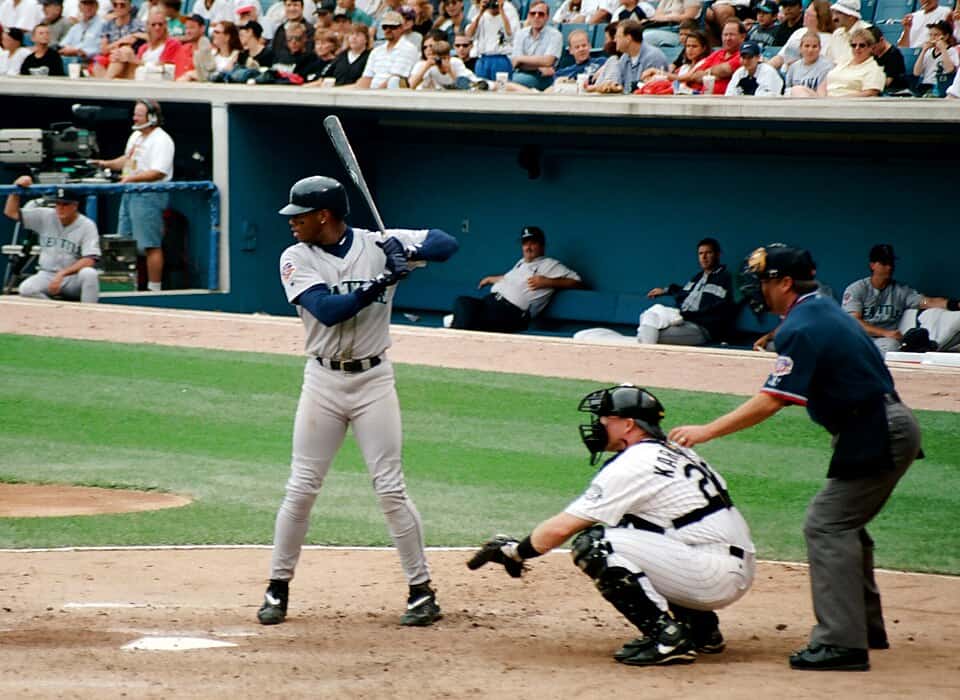
I was fortunate to watch many great pro baseball players while growing up in the 1990s and early 2000s. But the first non-Mets player that always comes to mind is someone who I could typically only watch highlights of on SportsCenter each morning: Ken Griffey Jr.
Many afternoons were spent in my room and backyard trying to emulate his swing and swagger in the batter’s box. It never quite happened, but you can’t blame me for trying, right? Heck, there’s still an old Wheaties box of him in the middle of his home run strut in my childhood room.
Griffey is the definition of an inner-circle Hall of Famer. He received 99.3% of the BBWAA vote in his first year on the ballot, and if he had simply retired following the 1999 season after an incredible 11-year run with the Seattle Mariners, he probably still would’ve found his way into Cooperstown rather easily.
That’s what I’d like to focus on. And, more specifically, I want to talk about his incredible prime from 1993-2000, how he dominated in the homer category in multiple ways, and how his career still leaves us with a “what could’ve been” taste in our mouths.
Related: The Ultimate Guide for Career Home Run Leaders
Ken Griffey Jr.’s Unreal Prime & All His Accomplishments

The 1993 season was Griffey’s age-23 campaign. He had already established himself as one of the game’s brightest stars at this point. The outfielder entered the season fresh off consecutive 20-homer, 100-RBI efforts, along with winning a pair of Gold Glove Awards.
But what he did in 1993 and continued to do until Y2K is what solidified his spot in Cooperstown.
Griffey slugged 45 homers in 1993, which was his first of seven such performances across eight years. The only time he didn’t reach the 40-homer plateau was in 1995 — he hit 17 while being limited to 72 games.
An average year for the sweet-swinging left-handed hitter during this time included a .294/.387/.606 line with 44 homers, 26 doubles, 116 RBI, 107 runs scored, and 14 steals. He surpassed the 50-homer plateau twice (56 in 1997 and 1998…more on those seasons in a bit) and won the regular-season AL home run crown four times (1994 and 1997-99).
Griffey went to the All-Star Game each season and won the AL MVP in ‘97 while also collecting seven more Gold Gloves and six Silver Slugger Awards. But the individual distinctions didn’t stop there!
His 351 homers between 1993 and 2000 were the most in MLB, edging out Sammy Sosa (349). He set a record by winning three Home Run Derby titles (1994, 1998-99). Oh, and he also tied Dale Long and Don Mattingly for most consecutive games with a home run in 1993 with eight.
But What Could’ve Been If He’d Stayed Healthier?
One of the biggest reasons Griffey put up those huge numbers with the Mariners in the ‘90s was because he mostly stayed on the field. That good fortune didn’t follow him to Cincinnati.
Outside of his rookie season (127 games in ‘89), the strike-shortened season (111 games in ‘94), and an injury-shortened 1995 campaign (72 games), he was in the lineup just about every day. Over his first 12 big-league seasons, Griffey suited up for at least 140 games nine out of 12 times.
He landed with the Reds in time for the 2000 season, and it was more of the same. Griffey slashed .271/.387/.556 with 40 homers, 22 doubles, 118 RBI, and 100 runs scored in 145 games.
However, Junior didn’t play in more than 130 games again until 2007. The span between 2001 and 2004 was especially painful to watch. Was Griffey exiting his physical prime at that point? Sure — those were his age-31 to age-34 campaigns.
But these were still prime years to rack up the counting stats in a potential pursuit of Hank Aaron on MLB’s all-time home run list. Griffey’s triple slash during these four years wasn’t far off his 40-homer campaign in 2000 with Cincinnati: .266/.360/.512.
He just couldn’t stay on the field. After appearing in 111 contests in 2001, Griffey failed to play in more than 83 games during each of the following three seasons. That led to him being on the field for about 49% of Cincy’s possible regular-season games.
Finishing with 630 career homers is an amazing feat — only six other players have hit more than him. However, it’s still quite the mental exercise to wonder where Griffey might’ve landed had he managed to stay a little healthier during the initial portion of his Reds tenure.
My Favorite Ken Griffey Jr. Stat of All-Time

You might’ve noticed that Griffey finished 1997 and 1998 with the same number of home runs (56). But that’s just the start of the similarities between his two campaigns. Check out Junior’s stats across several categories and how they compare to one another:
- 1997: 34 doubles, 3 triples, 56 home runs, 147 RBI, 76 walks, 121 strikeouts
- 1998: 33 doubles, 3 triples, 56 home runs, 146 RBI, 76 walks, 121 strikeouts
He was quite literally an RBI double away from having the same season-long totals across six different categories in consecutive years! I love that on its own, but this goes one level deeper. Griffey actually hit his 50th home run in each season exactly one year apart. Those milestone taters were both launched on September 7.
Baseball, man. You just can’t make stuff like that up.
Love home runs? Grab my MLB Home Run Almanac for FREE — all-time, single-season, and postseason leaders for all 30 franchises — and get home run history delivered to your inbox twice a week.