When it comes to collecting baseball legends, Cal Ripken Jr. can be considered as one of the hobby’s most enduring figures of the last 50 years.
The Iron Man’s cards have had steady interest for decades, but you don’t need to break the bank to own one. Sports Illustrated’s Horacio Ruiz recently walked us through five rare and affordable options, and he highlighted one Cal Ripken Jr. baseball card in particular that caught my attention.
Editor’s Note: The Sports Card Cash-Out System Guide is Here… Buy it now!
The 1995 Pinnacle White Hot: A Cal Ripken Jr. Baseball Card with Serious Visual Pop

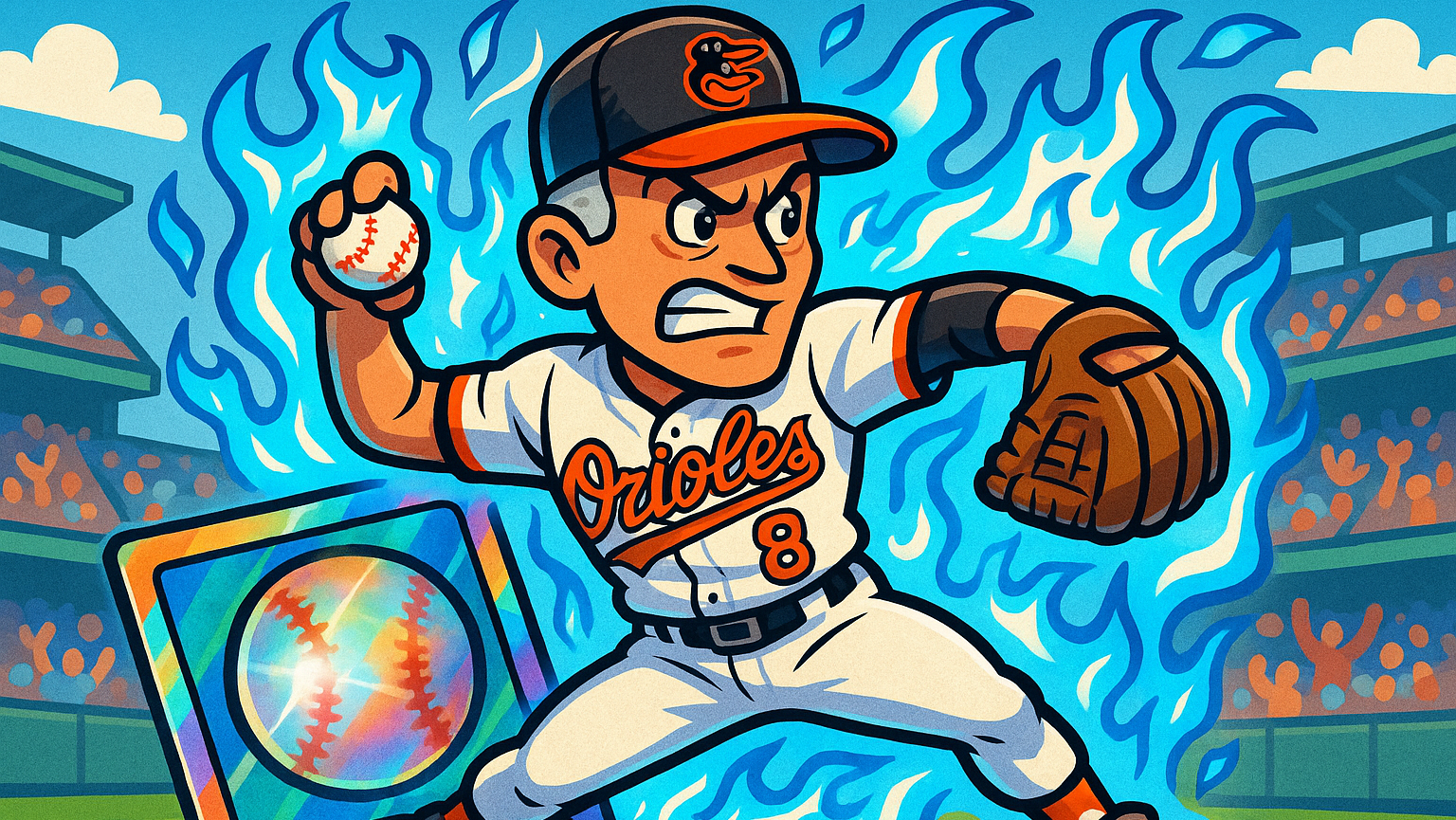
The 1995 Pinnacle White Hot insert series fully paralleled the Red Hot set, but with a twist that makes it stand out even more. Ruiz noted that these cards featured “the same player photos but utilized a blue and white fire-themed background with a Dufex finish.”
That Dufex technology gives the card an awesome shimmer and movement that perfectly complements Ripken’s throwing motion, which you can see in the above photo.
This is interesting from a timing perspective because it was the year Ripken officially etched his name on what many probably think is an unbreakable record. On September 6, 1995, he broke Lou Gehrig’s record of 2,130 consecutive games played. So, this card was released at the pinnacle of Ripken’s trek toward setting a new standard for durability.
Ungraded versions of this card are selling for just $35-$50, according to eBay. That’s incredible value considering what you’re getting. The exact print run isn’t publicly documented, which I think adds to the card’s mystique and scarcity. PSA’s population report shows relatively few graded examples in circulation, particularly in gem mint condition.
So, this card has some long-term potential with Ripken’s legacy within the game cemented.
Cal Ripken Jr.’s Enduring Impact on the Hobby
Although Ripken last played in 2001 and was inducted into the Hall of Fame in 2007, his brand has continued to grow, particularly with his Little League empire that’s introducing new generations to the game.
What makes Ripken special in the hobby is two-fold. He represents nostalgia for older collectors who watched him play, as well as aspirational values for newer collectors who appreciate what he stood for: consistency, durability, and showing up every single day.
That keeps his cards relevant across different target demographics. The fact that he extended his consecutive games streak all the way to 2,632 games before voluntarily ending it in 1998 doesn’t hurt, either. That’s a power move if I’ve ever seen it.
Record-Breaking Cal Ripken Jr. Baseball Card Sales
While affordable options like the White Hot exist, Ripken’s top cards have raked in serious money at auction. His 1982 Topps Traded rookie card has seen PSA 10 examples sell for over $30,000 in recent years. That card is the foundation of his collectibility, and it’s consistently ranked among the most important rookie cards of the 1980s.
Another heavyweight is the 1982 Topps regular issue card. Although it’s not technically his rookie, it’s seen gem mint examples fetch $3,000-$5,000. Then there’s the ultra-rare 1982 Fleer variation, where printing errors and scarcity have pushed certain versions into five-figure territory.
These high-end sales prove that serious money follows Ripken’s name, but they also highlight how accessible his mid-tier and insert cards still are by comparison.
The Iron Man’s Hall of Fame Career
The consecutive games streak is compelling in its own right, but the rest of Ripken’s career stats are also worth noting. He joined the 3,000-hit club on April 15, 2000, becoming the 24th player to achieve that milestone. The right-handed hitter eventually finished with 3,184 career knocks. His 431 home runs and 1,695 RBI helped redefine what a shortstop could do offensively, especially at his height (6’4″).
Ripken won two MVP awards (1983 and 1991) and made 19 All-Star appearances while also winning two Gold Gloves, eight Silver Sluggers, and being part of the Baltimore’s 1983 World Series-winning club. The Iron Man’s 2007 Hall of Fame induction resulted in him earning 98.5% of the vote.
His streak of playing 2,632 consecutive games is a testament to durability in an era when the game was changing rapidly. Since Ripken’s streak ended, Miguel Tejada managed to play in 1,152 straight games. While that’s impressive, it was still not even half of Ripken’s total.
No player in the 21st century has crossed 1,000 consecutive games. That’s how extraordinary Ripken’s achievement was, and it’s why his cards continue to get attention all these years later.
Love home runs? Sign up for my Substack today and start getting interesting home run-related observations straight to your inbox! And if you’re new to MLB Daily Dingers, you should start here.