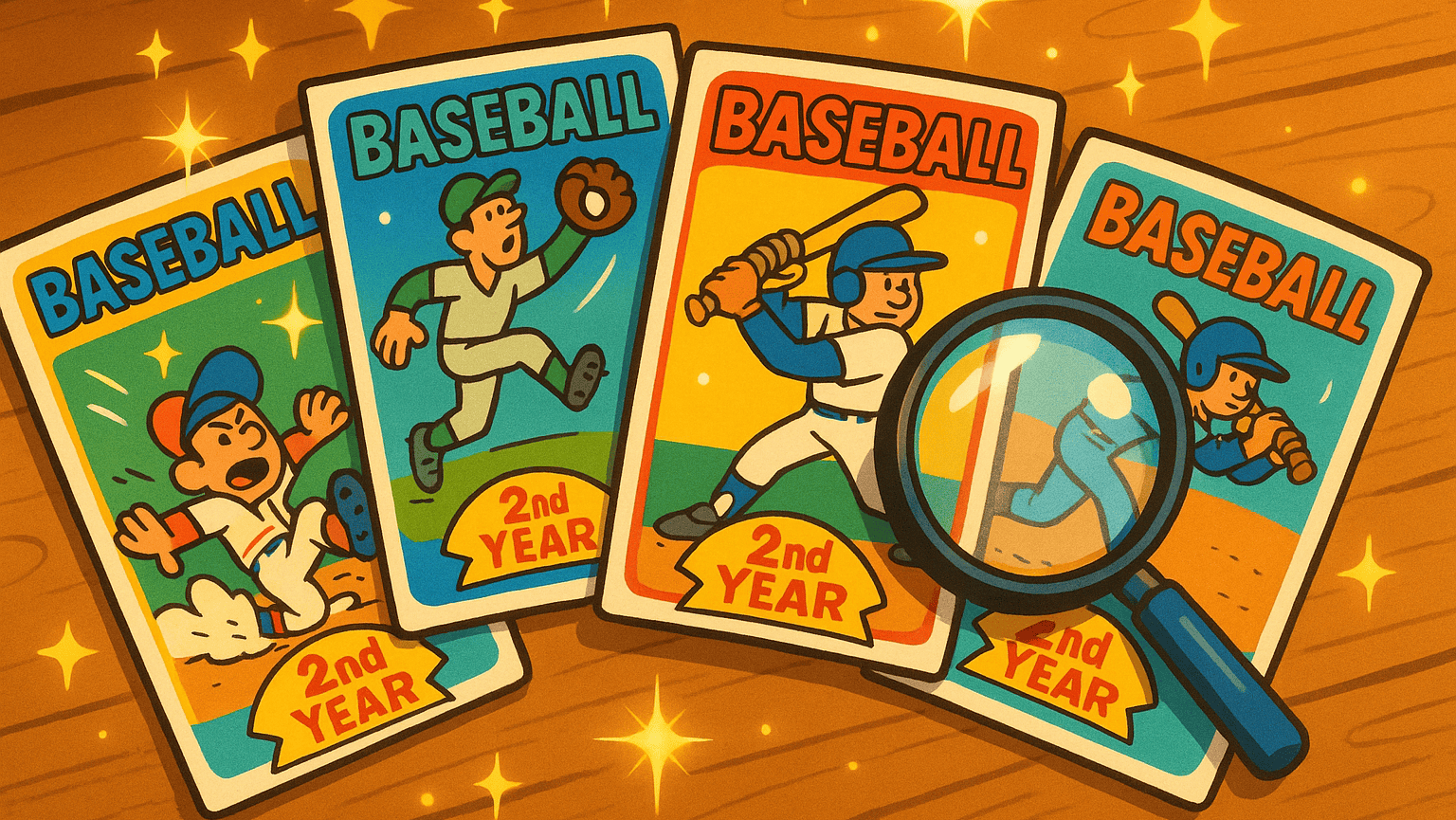
While most people chase coveted rookie cards, there’s another strategy that collectors could be employing. Year-two cards often deliver a better bang for your buck — and sometimes, it’s just better altogether.
David Gonos of the Happy Hobby Newsletter put together a terrific deep dive that explores 59 different 2nd-year Topps baseball cards from 1953-81 and why they deserve more attention. After spending way too much time looking at each of his selections, I settled on my 10 favorites and listed them below.
Editor’s Note: Looking to Sell Sports Cards? Here’s How to Do It Quickly & Easily
10 Terrific 2nd-Year Topps Baseball Cards Worth Chasing
According to Gonos, the following 2nd-year Topps baseball cards are a small cross-section of the ones we should be paying more attention to:

1981 Topps Rickey Henderson #261: Henderson’s second-year card features a cleaner design than his 1980 rookie and can be found in PSA 9 condition for around $150-300.

1980 Topps Ozzie Smith #393: The Wizard’s sophomore card shows him in action and typically trades between $75-200 in high grade.
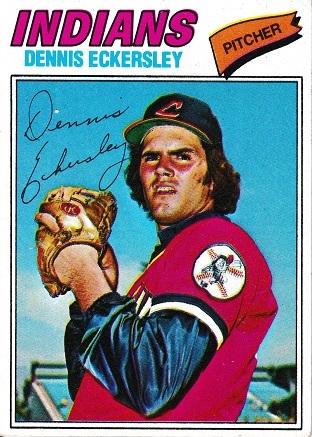
1977 Topps Dennis Eckersley #525: Eckersley’s second-year issue captures him as a young starting pitcher and remains surprisingly affordable at $30-80 in nice condition.
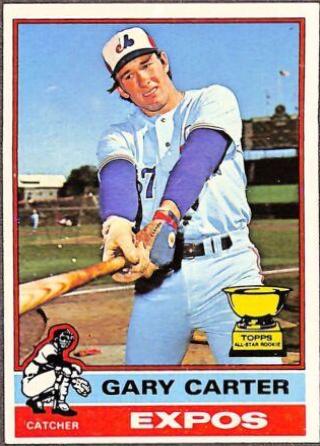
1976 Topps Gary Carter Rookie Cup #441: Carter’s first single-player card (his RC was a multi-player issue) commands $50-150.
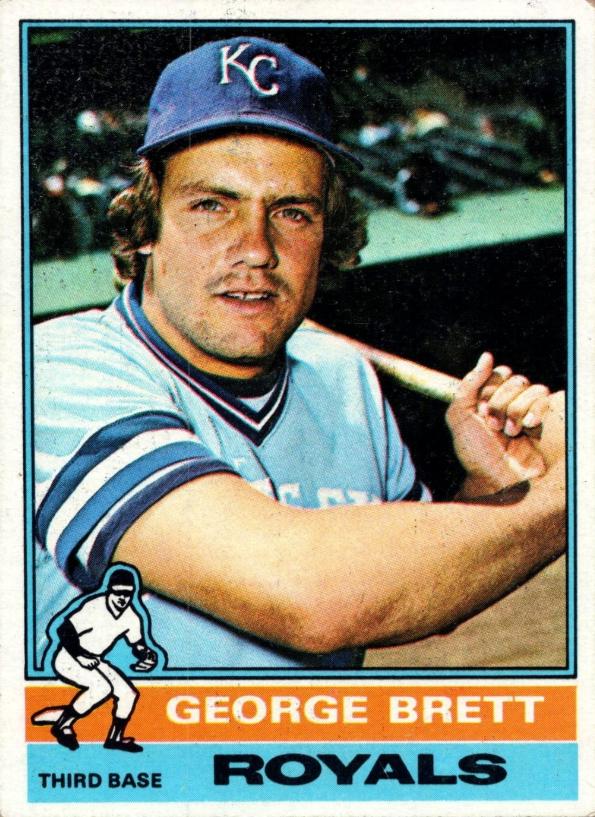
1976 Topps George Brett #19: One of the most iconic cards of the 1970s, Brett’s sophomore issue ranges from $100-400 in excellent condition.

1970 Topps Reggie Jackson #140: Mr. October’s second-year card is a classic that sells for $75-250 in quality grades.
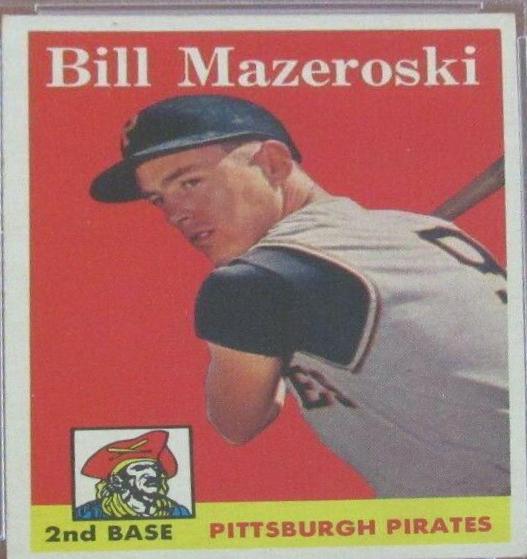
1958 Topps Bill Mazeroski #238: This vintage beauty from the late 1950s can still be acquired for $40-100 in lower grades. That’s incredible value for a Hall of Famer’s early cardboard.
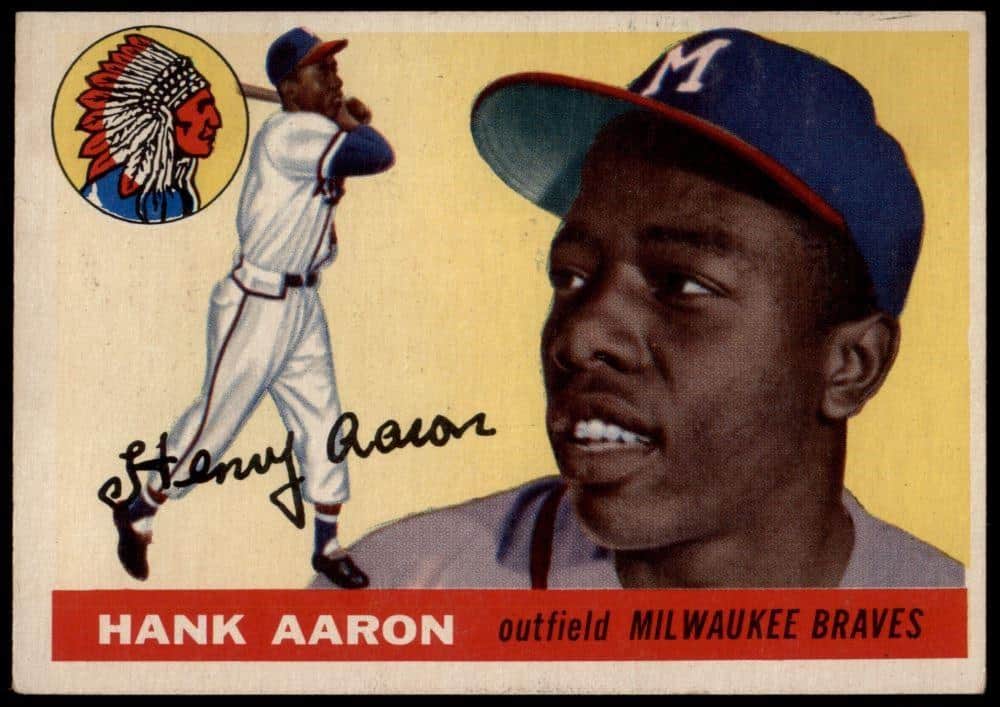
1955 Topps Henry Aaron #47: Hank Aaron’s sophomore card is legendary, featuring a bold 1950s design and commanding $300-1,000+ depending on condition. That’s a lot of money, but it’s still significantly cheaper than his rookie card.
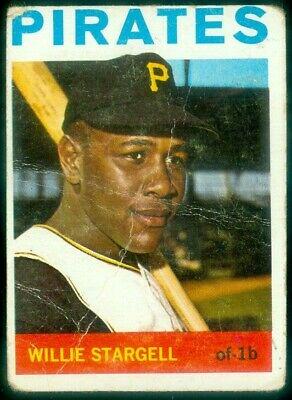
1964 Topps Willie Stargell #342: Stargell’s first single-player card (following his multi-player RC) typically runs $60-200 in solid condition.
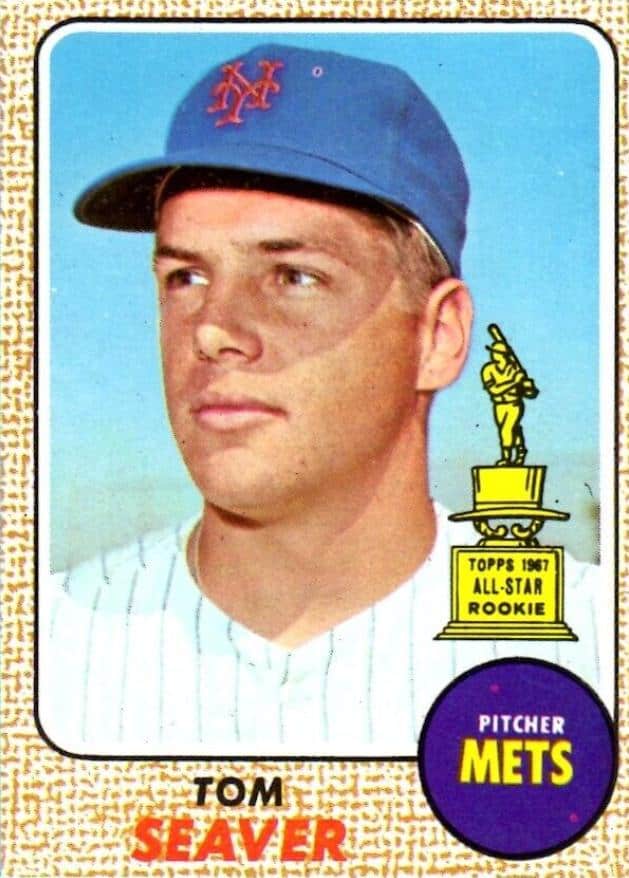
1968 Topps Tom Seaver Rookie Cup #45: Tom Terrific’s first solo card after his multi-player RC trades for $100-350 in nice shape and is still a cornerstone piece for Mets collectors.
Why Rickey Henderson’s 1981 Topps Card Is Underrated
Rickey Henderson’s 1981 Topps #261 shows the Man of Steal at the beginning of one of baseball’s most revolutionary careers. While his 1980 rookie card gets all the attention (and fetches prices north of $1,000 in gem mint), his second-year issue is no slouch.
The 1981 card’s design is cleaner and more focused than the busier 1980 Topps layout. This card also documents Henderson at the start of his record-breaking stolen base rampage. Sure, he’d already led the league in steals in 1981 (100) and 1982 (56 in a strike-shortened season), but 1982 was the high-water mark for the speedster. He stole 130 bags for the Oakland Athletics that year, which is still a modern-day single-season record.
Henderson retired with 1,406 career stolen bases, 2,295 runs scored, 3,055 hits, 2,190 walks, and a personality that made him one of baseball’s most quotable characters. His impact on the game (and the leadoff spot) makes any of his early cards worthwhile investments.
The Wizard’s Sophomore Magic
Ozzie Smith’s 1980 Topps #393 captures one of the greatest defensive players in baseball history at the start of his legendary career. While his 1979 rookie card is a focus for many collectors, the 1980 issue showcases Smith finishing his swing, which feels a little more unique because when I think of Ozzie, my first thoughts immediately go to him playing the field.
Smith would go on to have one of the most impressive defensive careers ever at shortstop, winning 13 straight Gold Gloves and being named to 15 All-Star teams, all while constantly wowing the crowd with his iconic backflips.
His second-year card is particularly appealing because it shows Smith before he became a superstar with the St. Louis Cardinals. This is Ozzie as a San Diego Padre, still establishing his reputation as the best defensive shortstop of his era. For collectors, it’s a chance to own a piece of history before the legend fully crystallized—and do so without breaking the bank.
Why Second-Year Cards Make Sense For Your Collection
Second-year baseball cards can sometimes have better action shots compared to rookies. By year two, photographers have had a full season to capture these players in motion, creating more dynamic and memorable images.
The pricing advantage is obvious but worth mentioning again. You can often grab a Hall of Famer’s second-year card for 50-70% less than their rookie, sometimes even more. That difference allows the opportunity to build deeper collections rather than sinking everything into a single RC. You’re getting nearly the same historical significance at a much better value.
There’s also something satisfying about owning the card that represents a player’s first full season (or two) of success. These aren’t speculative prospects anymore—they’re established major leaguers whose second-year cards document the start of their legendary careers.
Love home runs? Sign up for my Substack today and start getting interesting home run-related observations straight to your inbox! And if you’re new to MLB Daily Dingers, it’s probably best to start here.