Fred McGriff never hit 40 home runs in a season. He never led the league in that category more than twice. He never won an MVP award.
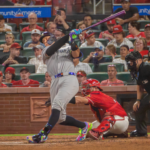
But that didn’t stop the Crime Dog from compiling some impressive statistics on his way to (eventually) being enshrined in Cooperstown at the National Baseball Hall of Fame. One of the more memorable days of his career likely came on June 2, 2000, when he slugged a two-run homer off Glendon Rusch of the New York Mets in the sixth inning of a game at Shea Stadium.
That punched his ticket to becoming the 31st member of the 400-homer club. Now that it’s been 26 years since McGriff reached this milestone, let’s revisit the moment and look back on what was an impressive 19-year run as a player.
Related: The Ultimate Guide for Career Home Run Leaders
Fred McGriff’s 400th Home Run Landed in the Shea Stadium Seats

By the time McGriff landed with the Devil Rays in 1998, he had already put together a noteworthy career, which included stops with the Toronto Blue Jays, San Diego Padres, and Atlanta Braves. And even into his mid-30s, the Crime Dog was still taking a bite out of opposing pitchers.
He posted an .815 OPS with 19 homers and 81 RBI in 1998, followed by a .957 OPS with 32 homers and 104 RBI in 1999. He was on his way to another impressive year at the plate for Tampa Bay in 2000, which included the above milestone moment.
McGriff’s 400th homer was a two-run shot to straightaway center that gave the Devil Rays a 3-2 lead. They’d eventually lose by a score of 5-3 to the Mets, but for a squad that fell to 18-35 and was essentially already out of serious playoff contention, it came secondary to McGriff’s milestone.
He became just the sixth first baseman in MLB history to reach 400 home runs. The bat he used to make history in Queens has taken up residence at the Hall of Fame in Cooperstown.
A Year of Milestones: 400 Homers, 2,000 Hits, and a Dual-League Record
As it turns out, this was just the beginning of some important moments throughout the 2000 season for McGriff. A couple of days later, on June 4, he recorded his 2,000th career hit, becoming the 211th big-leaguer to reach that benchmark. He finished his career with 2,490 total knocks.
And last but most certainly not least, he took Roy Halladay of the Blue Jays deep on September 23, joining Frank Robinson as just the second player to register 200-plus homers in both the National League and American League.
McGriff’s on-field performance in 2000 wasn’t as impressive as the year prior (he posted a 4.0 bWAR in ’99 compared to 0.2 in ’00), but the counting numbers were still there in his age-36 campaign. He was Tampa Bay’s lone representative at the All-Star Game and finished the year with a .277/.373/.452 line in 664 plate appearances. It was accompanied by 27 homers, 106 RBI, and 82 runs scored. The left-handed slugger just missed registering his ninth season of 30-plus homers, but he’d do it the following year (31 in 2001) and once more in 2002 (30 on the dot).
The Seven Homers That Delayed His Cooperstown Induction
McGriff finished just seven homers short of the 500-homer club. While it’s probably an honor to be tied on the all-time list with Lou Gehrig, he retired excruciatingly close to what used to be an automatic ticket to Cooperstown. It doesn’t seem like a lot, but combine this with being overshadowed by other sluggers during the Steroid Era, and it’s not all that surprising.
In his 10 years on the BBWAA ballot, McGriff received more than 25% of the vote just once. That happened during his last year on the ballot, getting 39.8% of the votes in 2019. But this long-overdue injustice was rectified in 2023 when he appeared on the Contemporary Era Ballot. McGriff needed at least 12 of the 16 votes for enshrinement, and he appeared on all 16 of them.
It’s hard to argue when you look at his full body of work, which spanned 19 seasons. The Crime Dog owns a lifetime .886 OPS to go along with 493 homers, 1,550 RBI, and 1,349 runs scored. He hit 30 or more home runs on 10 occasions and recorded 80-plus RBI each year between 1988 and 2002 (this stretch included eight seasons of 100-plus RBI).
We can’t forget that McGriff slugged at least 30 homers in a season for five different MLB teams — that’s something he and Gary Sheffield both have in common. The Crime Dog was one of his generation’s most consistently elite (and underrated) hitters. The 400-homer moment at Shea was a small flash of recognition during a career that deserved more of them.
Love home runs? Grab the free MLB Home Run Almanac — all-time, single-season, and postseason leaders for all 30 franchises — and get home run history delivered to your inbox twice a week.