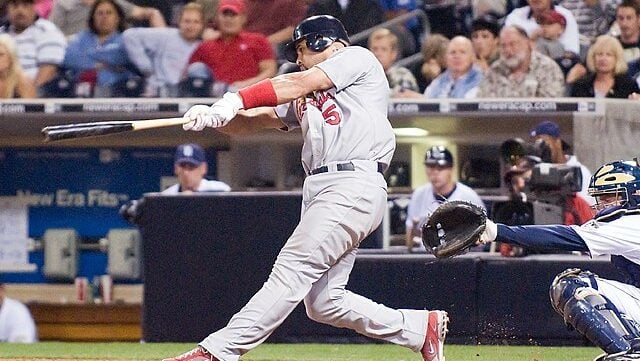
When Albert Pujols broke into the majors in 2001, even the most optimistic predictions wouldn’t have fully captured the excellence he sustained for an entire decade. But that’s exactly what happened. The numbers from his first 10 seasons are almost too ridiculous to believe.
We’re talking about a stretch of dominance to begin a big-league career that rivals anything the game has ever seen (in my humble opinion). Let’s dive into just how absurd The Machine was during his first tour with the Cardinals.
Editor’s Note: Looking to Sell Sports Cards? Here’s How to Do It Quickly & Easily
Albert Pujols’ First Decade: Numbers That Defy Logic

Between 2001 and 2010, Pujols orchestrated one of the most statistically dominant decades in baseball history. His cumulative line reads like something straight out of a video game. He slashed .331/.426/.624 with 408 home runs, 426 doubles, 1,230 RBI, and 1,186 runs scored across 1,558 games.
That led to 81.4 bWAR over 10 seasons, which averages out to more than 8.0 bWAR per year. I’d say that’s quite valuable, and it’s even more insane when you consider the fact that his worst batting average in a single season during that span was .312. Among qualified hitters in 2025, only one player finished with a batting average higher than that (Aaron Judge hit .331).
Pujols posted an OPS above 1.000 in eight of those 10 seasons, dipping to “only” .955 in 2002 and .997 in 2007. During an average year in this stretch, Pujols crushed 41 homers with 43 doubles, 123 RBI, and he scored 119 times.
The Hardware Collection: MVPs, All-Stars, and Everything Else
You don’t put up those numbers without collecting some serious hardware along the way. Pujols’ trophy case from 2001-10 looks like it belongs in Cooperstown already:
- 2001 NL Rookie of the Year
- Three-time NL MVP (2005, 2008, 2009)
- One batting title (.359 in 2003)
- Top-10 MVP finishes in every single season
- Nine All-Star selections (missed 2002)
- Six Silver Slugger Awards
- Two Gold Glove Awards
He led the National League in homers twice, RBI once, runs scored five times, and bWAR six times. Oh, and he helped deliver a World Series title to St. Louis in 2006 (he won another in 2011, but that falls outside of the time range we’re talking about right now).
Where Albert Pujols’ Run Stands Among All-Time Great Performances
Comparing eras is always tricky in baseball, but when you stack Pujols’ first decade up against other legendary streaks, the conversation gets really interesting.
According to Baseball Almanac, only four players have ever recorded at least 10 seasons with a .300 average, 30-plus homers, and 100-plus RBI: Babe Ruth (12 seasons), Lou Gehrig (10), Manny Ramirez (10), and Pujols (10).
Here’s the kicker: Pujols is the only one who did it in 10 consecutive years, and right from the start of his career. Ruth needed time to transition from pitcher to slugger. Gehrig took a few years to get going. Ramirez had the counting stats scattered throughout his career. But Pujols? He showed up in 2001 and just refused to have anything less than an elite season for a full decade.
Pujols even comes out ahead when compared to Ken Griffey Jr. The Kid’s first 10 full seasons (1989-98) produced a .300/.379/.568 slash line with 65.8 bWAR. Phenomenal numbers, right? Pujols topped him in virtually every category while adding 15.6 more bWAR.
Albert Pujols’ Place in the Baseball Card Collecting World

If you’re a collector, you already know that Albert Pujols rookie cards and early-career issues are blue-chip investments. The dominance we’ve been discussing translates directly into hobby value.
His 2001 Bowman Chrome Autograph (particularly in high grades) routinely fetches five figures at auction. A BGS 9.5 recently sold for over $30,000. The 2001 Topps Chrome Refractor rookie consistently commands strong prices, especially in gem mint condition. Even his base Topps rookie from 2001 holds significant value (a PSA 10 can run you several hundred bucks).
But it’s not just the rookie cards. Pujols’ autographed cards from 2003-06 carry serious value. His 2005 Upper Deck Ultimate Collection patch auto? Those can crack $1,000 in top condition. Cards from his 2006 championship season? Same story.
The market recognizes what the stats show: those first 10 years were historically significant. Collectors who invested in Pujols during his Cardinals prime made excellent decisions. With his Hall of Fame eligibility approaching, those cards should maintain strong long-term value.
Love home runs? Sign up for my Substack today and start getting interesting home run-related observations straight to your inbox! And if you’re new to MLB Daily Dingers, it’s probably best to start here.