There’s always something interesting happening in the vintage baseball card world. The recent sale of a pristine Tony Gwynn rookie card proves collectors are still willing to pay premium prices.
According to Sports Illustrated’s Matt Schilling, a PSA 10 example of the 1983 Fleer Tony Gwynn rookie card (#360) just changed hands for $492. This is a testament to Gwynn’s legacy and his timeless appeal…especially when we’re talking about a perfectly preserved piece of cardboard from the early 1980s.
Editor’s Note: Start Your Sports Cards Quickly & Easily Today
What Makes This Tony Gwynn Rookie Card So Special?
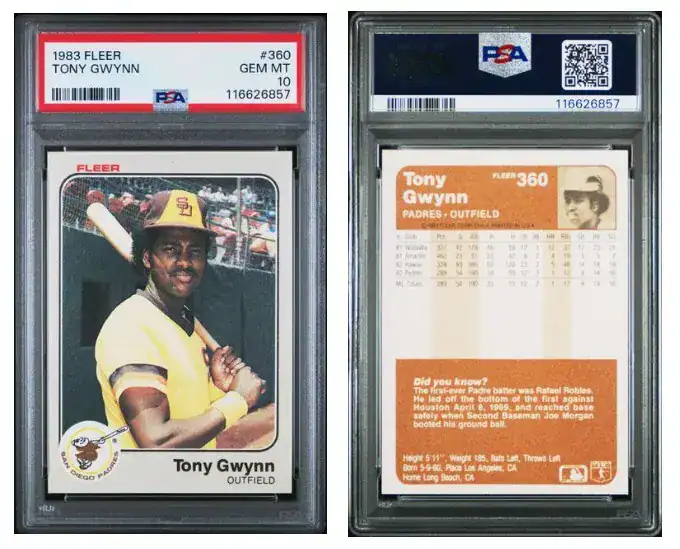
This was one of three rookies Schilling highlighted from the 1983 Fleer release, and the details surrounding this particular sale are fascinating. The Gwynn card captures the left-handed hitting machine during the earliest days of his professional career. In PSA 10 condition, it represents the pinnacle of preservation for a release that happened more than 40 years ago.
There are only 900 PSA 10 examples in existence, compared to 4,161 PSA 9s and 5,321 PSA 8s, which Schilling noted from PSA’s population report. That scarcity at the highest grade creates serious demand. The September 3 sale shows that premium examples of this card continue to command strong prices. It’s a lot higher than raw copies, too, which typically trade in the $7.50-$10 range.
What I find particularly interesting is how this card has maintained its value trajectory. Although it’s not as expensive as its 1983 Topps counterpart in the same condition, the Fleer version holds its own appeal for set collectors and those who appreciate the distinctive design.
Other Valuable Tony Gwynn Cards Worth Chasing
Beyond the 1983 Fleer rookie, Gwynn collectors have several other high-value options to pursue. The 1983 Topps Tony Gwynn rookie (#482) is still the flagship card from his rookie year, typically fetching higher prices than Fleer’s version (especially in top grades).
For those looking at more modern options, Gwynn’s certified auto cards from the late 1990s and early 2000s have become more popular, especially after he passed away in 2014 at the way-too-young age of 54.
His 1984 Donruss and 1984 Fleer Update cards also generate strong collector interest. But if you’re hunting for true gem-mint examples that combine scarcity with Hall of Fame pedigree, you can’t go wrong focusing on those 1983 rookies.
Why Tony Gwynn Remains a Collectibles Icon
Gwynn’s Hall of Fame career speaks for itself, which is a big reason why his cards maintain such strong demand decades after his retirement. The man won eight National League batting titles, collected 3,141 career hits, and never once struck out more than 40 times in a season, which is just about damn near unthinkable in today’s game.
His .338 lifetime batting average currently ranks as the 23rd-highest mark of all time. He was a hitting machine and one of my favorite players growing up in the 1990s.
But what truly sets Gwynn apart in the collectibles world is his connection to San Diego. He’s become synonymous with the franchise, which is bound to happen after playing for 20 years in the same city. That loyalty, combined with his incredible talent and genuine personality, created a perfect storm for collectible appeal.
The Fleer Legacy: Rise, Fall, and Lasting Impact
Fleer’s story adds another fascinating layer to the appeal of these cards. They revolutionized the baseball card industry by breaking Topps’ monopoly in 1981, bringing competition and innovation to a hobby that needed both badly.
Unfortunately, Fleer closed its doors in 2005. Upper Deck eventually acquired the rights to the brand. That adds a bittersweet nostalgia to vintage Fleer cards since the company is no longer with us, but they left quite a mark on the hobby.
The 1983 Fleer set, with its rookie cards of Gwynn, Wade Boggs, and Ryne Sandberg, is one of the company’s best achievements. These cards are artifacts from a transformative period in the industry, produced by a company that dared to challenge the status quo, and before the Junk Wax Era took effect.
Love home runs? Sign up for my Substack today and start getting interesting home run-related observations straight to your inbox! And if you’re new to MLB Daily Dingers, it’s probably best to start here.