When people think about mid-’80s collectibles, 1985 Fleer baseball cards often fly under the radar. That’s a shame, because this set delivered an excellent rookie class while maintaining Fleer’s reputation for clean design.
The gray-bordered cards might not grab headlines, but you’ll find future Hall of Famers, legendary pitchers, and cards that can still fetch serious money in top grades today.
Editor’s Note: Looking to Sell Sports Cards? Here’s How to Do It Quickly & Easily
5 Awesome 1985 Fleer Baseball Cards (& What They’re Worth Now)
These five cards display some of the most collectible pieces from the ’85 Fleer release (all sale numbers via Sports Cards Pro):
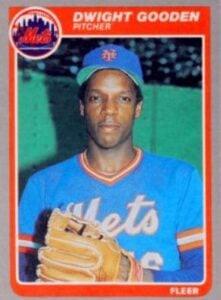
Dwight Gooden #82: Following his unreal 1984 debut, Doc’s first mainstream rookie has fetched between $370 and $800 in its six most recent sales in PSA 10 condition.

Don Mattingly #133: Donnie Baseball’s second-year card has recently sold in the $200-300 range as a PSA 10, reflecting his lasting popularity with Yankees fans.

Nolan Ryan #359: Despite thousands of PSA 10 examples available of this card, the Ryan Express can still sell for $300-plus in mint condition.
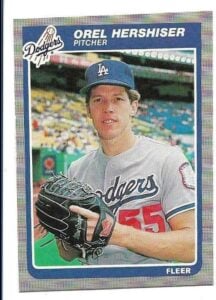
Orel Hershiser #371: The Bulldog’s rookie has sold for between $20-30 recently in PSA 9 condition, but that number can jump to $300 if it’s a PSA 10.

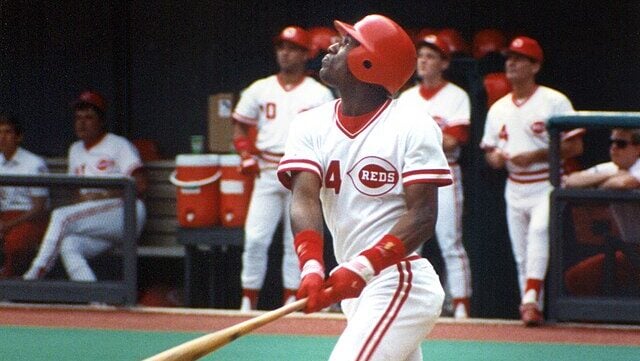
Eric Davis #533: Eric the Red’s PSA 10 copies can eclipse the $600 range. Of the most recent five sales for this condition, the final price has finished at $700 or more.
The Bulldog’s Rise: Orel Hershiser’s Breakout
Hershiser made his MLB debut with the Los Angeles Dodgers in 1983, but it was just a cup of coffee. He posted a 3.38 ERA across eight innings as a 24-year-old, exclusively as a reliever. But the following year is when he started to open eyes.
He went 11-8 with a 2.66 ERA, 1.11 WHIP, and 150 strikeouts in 189.2 innings (20 starts, 10 relief appearances). That was followed by an even more dominant 1985 campaign, which included a 19-3 record, 2.03 ERA, 1.03 WHIP, and 157 strikeouts in 239.2 frames. Hershiser finished third in National League Cy Young voting and 16th in MVP voting that year.
This breakout season helped the Dodgers to a 95-67 record and their second NL West title in three years. Hershiser’s first taste of postseason baseball came in Game 2 of the NLCS, where he allowed just two runs in a complete-game victory. The St. Louis Cardinals eventually won the series, but the right-hander had officially arrived, and he was just a couple of years away from a legendary 1988 Cy Young performance.
Eric Davis: The Promise of a Five-Tool Phenom
Davis played in parts of two seasons for the Reds in 1984 and 1985 before breaking out in ’86. Through his first 113 big-league games (331 plate appearances), the five-tool player struggled to a .233/.307/.486 line with 18 home runs, 13 doubles, four triples, 48 RBI, 59 runs scored, and 26 steals.
But the foreshadowing was there at the end of 1985. After struggling early in the season, he was sent down to Triple-A before making his return to the majors in September. Over his final 38 plate appearances of the season with Cincy, he slashed .406/.472/.781 with five extra-base hits (three homers), seven RBI, eight runs scored, and six steals.
And then came his true breakout campaign of 1986. Davis’ first full big-league season (132 games played) resulted in 5.3 bWAR off the strength of a .277/.378/.523 line with 27 homers, 15 doubles, 71 RBI, 97 runs scored, and 80 steals.
The following year (which included his first All-Star selection) was even better. He hit 37 home runs with 100 RBI, 120 runs scored, and 50 steals in only 129 games. These were video game numbers that had collectors frantically chasing his rookie cards. While injuries prevented Davis from putting together a career worthy of Cooperstown, his cardboard still carries weight.
The 1985 Fleer Release: Solid Design Meets Stellar Rookies
By the time 1985 Fleer baseball cards hit shelves, collectors knew what to expect from the company that ended Topps’ monopoly in 1980: solid design, solid photos, and organized numbering.
What really elevated this set was the rookie class. Gooden, Davis, Hershiser, Roger Clemens, Kirby Puckett, and Bret Saberhagen all made their mainstream debuts here. Each 15-card wax pack came with team logo stickers. Fleer also included “Super Star Specials,” featuring dual-player puzzle cards and “Major League Prospects” showcasing emerging talent.
Most importantly, the 1985 Fleer set had smaller print runs than competing releases that year. This helped cards maintain respectable values in high grades, unlike the junk wax avalanche arriving later. The set’s clean aesthetic and incredible depth ensure it remains a favorite.
Love home runs? Sign up for my Substack today and start getting interesting home run-related observations straight to your inbox! And if you’re new to MLB Daily Dingers, it’s probably best to start here.