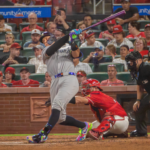
Chicago White Sox slugger Munetaka Murakami will be entering the month of May with at least 11 home runs.
That’s wild in its own right — especially for a rookie. It goes up a notch when you remember that most of baseball passed on him over the winter, though.
The 26-year-old broke Sadaharu Oh’s NPB home run record in 2022 after mashing 56 taters for the Yakult Swallows. And now, he’s making headlines with his ability to hit for power in the States.
The White Sox rookie home run record is 36, which was set by first baseman Jose Abreu in 2014. But if Murakami can maintain some semblance of his current pace, he could shatter it by season’s end.
Editor’s Note: New here? Grab the free MLB Home Run Almanac — all-time, single-season, and postseason leaders for all 30 franchises, updated through 2025.
How Chicago Got the Steal of the Offseason
When Murakami was posted last November, he was seen as one of the winter’s top free agents. Heck, MLB Trade Rumors projected he’d eventually sign an eight-year, $180 million contract. Their predictions for landing spots included the New York Mets, Boston Red Sox, and Los Angeles Dodgers.
All of those thoughts made sense. After all, Murakami was heading to MLB with premier power and two NPB MVP Awards on his mantle. It also didn’t hurt that he was only 25 years old.
Instead of signing one of the offseason’s most lucrative contracts, he settled for a two-year, $34 million deal with the White Sox. This already felt like a bargain, but it’s looking more absurd by the day.
How did this happen? Scouts noted that Murakami’s strikeout rate in NPB had crept up from 21% toward 30%. There were questions about whether that swing-and-miss would get exposed more consistently against big-league pitching, especially against high velocity.
Enough teams had concerns to let him slide to Chicago on a relatively modest deal. Is he still striking out a lot? Sure — his 33.1% strikeout rate through 118 plate appearances is quite high. However, it can be tolerated when it’s paired with a 18.6% walk rate, 11 homers, and a 159 wRC+.
It’s not like he didn’t warn everyone, ya know. Shortly after his White Sox deal was finalized, he told us he has plenty of power:
I asked Munetaka Murakami what makes him such a dangerous hitter.
— Chuck Garfien (@ChuckGarfien) December 23, 2025
His answer. 😂 pic.twitter.com/IU8Ouve5J5
Munetaka Murakami’s Production Through 27 Games
Ahead of Chicago’s series finale on April 26 against the Washington Nationals, Murakami’s total offensive production has been quite impressive.
Through his first 118 plate appearances, the left-handed slugger is slashing .242/.381/.589 with 11 home runs, 20 RBI, and 21 runs scored. That susses out to a .971 OPS, a 159 wRC+, and 1.1 fWAR. Although his 39 strikeouts also get your attention, he’s been among the game’s best hitters throughout the regular season’s first month.
Murakami’s quality-of-contact metrics are validating every bit of that power output. He’s paired a 49.1% fly-ball rate with a 14.0% soft-hit rate and a 50.9% hard-hite rate, according to FanGraphs.
And despite all the strikeouts, he’s shown impressive plate discipline. He’s averaging nearly one walk per game (25 free passes in 27 games), and his chase rate is sitting at just 19.6%.
The home runs are grabbing the headlines, and rightfully so. That’ll happen when you’re racking them up at a prodigious clip. But his performance is even more impressive when looking at his overall offensive profile and his peripheral stats.
The Records Are Piling Up

You can’t have a hot start to your big-league career without getting your name in the record books, right?
The latest one came from MLB.com’s Sarah Langs on X. She pointed out (with the help of Elias Sports) that Murakami’s first 11 extra-base hits have all been homers. That’s the longest such streak to start a player’s major league career since at least 1900, and it broke a tie at 10 with Dae-ho Lee. He accomplished that feat with the Seattle Mariners in 2016.
But wait…there’s more! Murakami homered in five straight games earlier this season, which did the following (h/t MLB.com’s Scott Merkin):
- Tied the White Sox franchise record for consecutive games with a home run (joining Frank Thomas, Paul Konerko, and Ron Kittle).
- Set a new record for Japanese-born MLB players, surpassing Shohei Ohtani and Seiya Suzuki, who each homered in four straight games.
- Tied the record for the longest such streak by any MLB rookie, which has been done 13 times before Murakami did it.
He also became the fastest player in White Sox history to reach 10 home runs in a season, doing it in just 24 games. The 26-year-old is tied with Trevor Story and George Scott for fourth-most home runs by any player in their first 24 career games since 1900. Aristides Aquino (12) and Rhys Hoskins (12) are the only hitters ahead of him at that mark.
Is Jose Abreu’s Rookie HR Record Already in Danger?
Abreu’s 2014 debut is one of the best rookie seasons in White Sox history. The first baseman hit .317/.383/.581 with 36 home runs, 35 doubles, 107 RBI, and 80 runs scored. That led to him winning AL Rookie of the Year while setting the franchise record for home runs by a first-year player that’s stood for 12 years.
Abreu had 10 homers by May 1, and Murakami is already slightly ahead of him. If he keeps up this ridiculous pace, we’re looking at a potential 60-homer season based on what FanGraphs is telling us.
Is that realistic? No, of course not. While we’re just over a month into the regular season, this is still a small sample size when we’re talking about a 162-game schedule. Pitchers will start to adjust and attack the zone differently when Murakami is in the batter’s box as the season drags on, and he’ll experience peaks and valleys in his production.
But even if he ends up at about half of his current pace, it’ll put him in a position to challenge Abreu’s record.
Will the Strikeouts Catch Up to Him?
The question mark on Murakami going into the season was always contact, and it hasn’t necessarily gone away. His 31% strikeout rate and 15.4% swinging-strike rate are numbers to keep an eye on moving forward.
However, Murakami’s profile is interesting because the same tools that led to the strikeout concerns are also behind the fact that his walk rate is pushing 20.0%. He doesn’t chase. He takes his walks. And when he makes contact, he doesn’t waste the opportunity.
The tools were never in question. How they’d translate in the big leagues compared to how he performed in the NPB was. And so far, it looks like things are going just fine.