While the explosion of the baseball card industry in the 1980s eventually led to the “Junk Wax Era,” this period produced some amazing cards that people are still chasing today.
Sports Illustrated’s David Solow recently put the spotlight on five different iconic 1980s baseball cards. Let’s talk about them each before I go into more detail about my favorite of the bunch.
Editor’s Note: Looking to Sell Sports Cards? Here’s How to Do It Quickly & Easily
Check Out These 5 Classic 1980s Baseball Cards
According to Solow, these five cards represent the pinnacle of 1980s baseball card collecting:
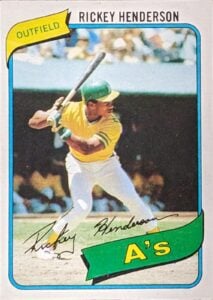
1980 Topps Rickey Henderson #482: This is the definitive rookie card for The Man of Steal, and it’s still in high demand. According to Sports Cards Pro data, the last four sales of a PSA 10 version for this card (since 2023 and all via Heritage Auctions) have hammered for at least $130,000.

1982 Topps Traded Cal Ripken Jr. #98T: Here, we have a young Ripken before all the accolades and records that came with his Hall of Fame career. There have been 16 different sales of PSA 10 examples in 2025, but the price has consistently reached five figures. The average sale price for a card in this condition checks in around $7,000.

1984 Donruss Don Mattingly #248: Isn’t this just an excellent shot of Donnie Baseball for his Donruss rookie? The average sale price for a PSA 10 example is close to $4,500, but the last two most recent sales on eBay have gone for more than $5,000.

1985 Topps Mark McGwire #401: Part of the groundbreaking 1984 U.S. Olympic team subset, PSA 10 examples of this RC featuring Big Mac can sell for around $4,000. It’s also worth noting that the Topps Tiffany version of this card recently sold for more than $30,000.

1989 Upper Deck Ken Griffey Jr. #1: Come on, you knew there was no way this card wasn’t going to make its way onto this list, right? This card is readily available in PSA 10 condition, but it’s regularly selling in the $4,000-5,000 range.
Why the 1980 Rickey Henderson Stands Above the Rest
While it was hard to pick just one card as my favorite from this bunch (you’ll see who else I wrestled with in a bit), I always end up gravitating back toward the Henderson rookie. And it’s mostly because it gives us an early look at someone who revolutionized what it meant to be a productive leadoff hitter.
Henderson’s career stats are always jaw-dropping to revisit, regardless of how often we do it. He racked up 1,406 steals, 2,295 runs scored, and 81 leadoff home runs during his 25-year Hall of Fame career. And that doesn’t even mention the 3,055 hits, 2,190 walks, 510 doubles, and 1,115 RBI also on his ledger.
Rickey was a 10-time All-Star, a two-time World Series champ, a three-time Silver Slugger winner, and he won the 1990 American League MVP Award. He did so by slashing .325/.439/.577 with 28 home runs, 61 RBI, 119 runs scored, and 65 steals in 136 games.
What makes this card particularly special is its rarity in high grades. The market reflects this scarcity. While PSA 8 examples trade around $295, PSA 9 copies jump to $2,100. Those ultra-rare PSA 10 slabs? The last one hammered at $144,000 in December at Heritage, according to Sports Cards Pro.
Tony Gwynn and Ken Griffey Jr.: Two Hitters I Was Lucky Enough to Watch
It won’t be seen here, but Solow also gave Tony Gwynn a shoutout as an honorable mention for his 1983 Topps rookie card. And although Mr. Padre didn’t make Solow’s cut, it was a three-horse race for me to pick between him, Griffey, and Rickey.
Gwynn and Griffey were two of the smoothest and purest hitters the game has ever seen. And I had the privilege of watching them in their prime since I grew up in the 1990s. While their rookie cards are from the ’80s, there are plenty of ’90s kids who treasure them (like me!).
Gwynn played his entire 20-year Hall of Fame career with San Diego. During that time, he compiled 3,141 hits and won eight batting titles—second only to Ty Cobb. His .338 career average still ranks among the best of all-time, too. Watching Gwynn work was a real treat, and I still love to revisit his “The Art of Hitting” book occasionally. I wore the pages of that book out as a young ballplayer.
And then there’s Griffey. That backwards cap, his effortless swing, the ridiculous defense in center field—Junior was appointment television. The 1989 Upper Deck #1 rookie changed everything about baseball cards. Upper Deck gambled by placing an 18-year-old who’d never played an MLB game as their #1 card. It worked out quite well.
What made Junior special was the complete package. His 630 career home runs are among the most of all time, but he also won 10 Gold Gloves and was a 13-time All-Star during his time in the big leagues. Griffey (like Gwynn) was a first-ballot Hall of Famer, but the only thing that annoyed me was that it wasn’t unanimous. Junior found his way into Cooperstown after receiving 99.3% of the vote.
The 1980s Baseball Card Collecting Experience
The vibe of collecting 1980s baseball cards was completely different from today. There wasn’t manufactured scarcity or calculated short prints. Companies printed massive quantities, and distribution was everywhere. Kids ripped wax packs on kitchen floors after stopping at the local convenience store, hoping to find their favorite player. They were just collecting cards because they loved it.
Topps, Fleer, and Donruss were locked in a competition, releasing large sets every year, but things shifted as the decade ended. The 1989 Upper Deck release was a turning point because premium features (thicker card stock, glossy surfaces, sharp photos, and anti-counterfeit holograms) were introduced. This was the beginning of a new era where cards were more clearly positioned as collectibles rather than just toys.
Which of these five iconic 1980s baseball cards brings back the most memories for you?
Love home runs? Sign up for my Substack today and start getting interesting home run-related observations straight to your inbox! And if you’re new to MLB Daily Dingers, it’s probably best to start here.