The 1984 Fleer baseball cards release was epic because it served up some Hall of Fame rookies with established legends during one of the hobby’s most transformative periods (and before the Junk Wax Era).
After looking through this release a bit, I picked five cards that were my favorites so we can talk about them in more detail.
Editor’s Note: Looking to Sell Sports Cards? Here’s How to Do It Quickly & Easily
5 Awesome 1984 Fleer Baseball Cards Worth Remembering
The 1984 Fleer set delivered serious star power across its 660-card checklist. The following five cards all caught my eye. I’ll also share the current value for each based on Sports Cards Pro data.
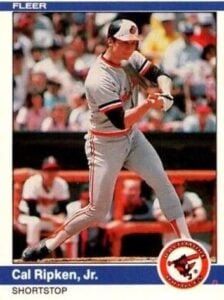
Cal Ripken Jr. #17: The Iron Man’s third-year card fetches between $50 and $80 in pristine PSA 10 condition.

Don Mattingly #131: Ah, a fresh-faced Donnie Baseball…with no trademark mustache! His rookie has recently commanded more than $900 in gem mint grade.

Nolan Ryan #239: Although the Ryan Express looks gassed here (or disgusted?), PSA 10 examples can fetch $170 on average.

Darryl Strawberry #599: Straw’s arrival in Queens marked the beginning of the Mets’ turnaround. The left-handed slugger’s rookie card can bring nearly $250 in pristine condition.

Tony Gwynn #301: Mr. Padre’s sophomore card shows him posing doing what he did best, and in classic San Diego threads. PSA 10 examples typically sell between $100 and $200.
Cal Ripken Jr.: The Iron Man’s Value Across Conditions
Ripken Jr. redefined what it meant to be a shortstop. At 6’4″, he brought size and power to a position traditionally reserved for smaller, defense-first players. His 1984 Fleer card captures him during those early years with the Orioles. While it was before Ripken’s consecutive games streak became truly noteworthy, he was fresh off winning both the American League MVP Award and the World Series for Baltimore in 1983.
The card’s market tells an interesting story about condition sensitivity. While PSA 10 examples sell around $60, PSA 9 copies typically trade in the $15-20 range, which is quite a drop in value. Centering issues plague many 1984 Fleer cards, making those perfectly centered examples much more valuable.
Ripken was a first-ballot Hall of Famer after earning 98.5% of the vote in 2007. In addition to his (probably) unbreakable record of playing in 2,632 straight games, he also racked up 3,184 total hits, 431 home runs, and 1,695 RBI across a 21-year career. He was also a 19-time All-Star, two-time MVP Award winner, eight-time Silver Slugger, and two-time Gold Glove winner.
His 1984 Fleer represents an affordable entry point into collecting one of baseball’s most respected figures.
Darryl Strawberry: Rookie Card Valuation Breakdown
Strawberry burst onto the scene with the Mets in 1983 as a 21-year-old, earning National League Rookie of the Year honors after launching 26 homers and 74 RBI with a .848 OPS in 122 games played. His 1984 Fleer rookie captures the slugging right fielder at the start of the Mets’ turnaround, and the longest run of sustained success in franchise history.
The Strawberry rookie has been selling between $200 and $300 in PSA 10 condition, according to Sports Cards Pro data. Raw, ungraded versions can be picked up for under $10, but the condition jump to PSA 9 brings values into the $50-75 range.
Strawberry’s career includes eight All-Star selections, three World Series rings, and 335 home runs across 17 seasons. The card design here is great. As we can see above, there are white borders with blue bands top and bottom, which lets Strawberry (and his pose) take center stage. For collectors chasing classic 1980s rookie cards, this remains an accessible target.
The 1984 Fleer Release: Where It Stands in Hobby History
Released during the height of competition between Topps, Donruss, and Fleer, the 1984 Fleer set featured clean design work. This minimalist approach created cards that have aged quite well.
The rookie class is what really distinguishes 1984 Fleer, though. Mattingly anchors the set as one of the decade’s most coveted first-year cards, while Strawberry and Andy Van Slyke round out the headliners. But the set’s personality shines through quirky photos. I mean, Glenn Hubbard’s card (#182) features him with a python draped around his shoulders, while Jay Johnstone (#495) sported a Budweiser umbrella hat.
Fleer also released its first Update set that year, a template that’d dominate hobby releases for decades. That 132-card boxed set included rookie cards of Roger Clemens and Kirby Puckett (neither player appeared in any regular-issue 1984 products). Together, the base and Update releases cemented 1984 as a big year for Fleer, proving they could compete with Topps’ decades-long dominance.
Love home runs? Sign up for my Substack today and start getting interesting home run-related observations straight to your inbox! And if you’re new to MLB Daily Dingers, it’s probably best to start here.