If you’re a vintage card collector, few sets hold more significance than 1952 Topps baseball cards. Topps’ first full-scale baseball card set (which was 407 cards deep) launched a new era of card collecting. Decades later, the cards still command serious money, attention, and competition among those who know exactly what they’re looking at.
There’s a lot to appreciate in this set, from the oversized design to the stacked checklist. Let’s take a look at five cards that caught my eye the most and what they’re currently worth in today’s market.
Editor’s Note: Looking to Sell Sports Cards? Here’s How to Do It Quickly & Easily
5 Classic 1952 Topps Baseball Cards Worth Knowing
Here’s a quick breakdown of five cards from the ’52 Topps set that most vintage collectors likely have on their radar. All images and valuation information are via Sports Cards Pro, unless otherwise noted:
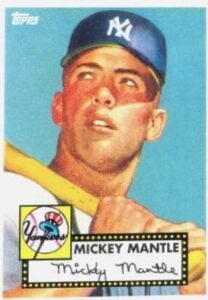
Mickey Mantle #311: I couldn’t leave out the most iconic card in the entire hobby! Recent sales for low-grade PSA-authenticated copies have landed anywhere from $27,000 to over $70,000, with mid-grade examples pushing well into six figures.

Hoyt Wilhelm #392: A Hall of Fame rookie card tucked into the tough high-number series. The most recent PSA 8 sales have gone for at least $10,000.

Pee Wee Reese #333: Here we have a prized Dodgers icon that costs a pretty penny. The last time a PSA 9 copy sold was in 2020. There were two sales that year, both going for $30,000.

Joe Adcock #347: A high-number card featuring the power-hitting first baseman with the Reds. A PSA 8 copy recently sold at Goldin for nearly $10,500.

Leo Durocher #315: The legendary manager and Giants skipper shows up right next to Mantle in Series 6. A Grade 7 version of this card was recently available on Sports Cards Pro for $1,300.
The Joe Adcock Card Is A High-Number Sleeper
Joe Adcock doesn’t get enough credit. The first baseman spent 10 of his 17 years in the big leagues with the Milwaukee Braves and put up numbers that still hold up pretty well.
Across nearly 2,000 games played, Adcock posted a .277/.337/.485 line with 336 home runs, 1,122 RBI, and 1,832 runs scored. And at the time of his retirement, he had the third-highest career fielding percentage for a first baseman (.994).
His most iconic moment came on July 31, 1954, when he launched four homers and a double off the wall against the Brooklyn Dodgers at Ebbets Field. His 18 total bases were an MLB record for 48 years before Shawn Green surpassed it in 2002.
Pee Wee Reese Was More Than Just a Shortstop
Pee Wee Reese’s legacy goes beyond what he did on the diamond, which is impressive because he was a pretty good ballplayer.
The 10-time All-Star and Hall of Famer spent all 16 years of his big-league career with the Dodgers. He was part of seven National League pennant-winning clubs and was on the roster for Brooklyn’s 1955 World Series title run.
But part of Reese’s lasting impact on the sport is his famous gesture of putting his arm around Jackie Robinson in front of a hostile Cincinnati crowd early in Robinson’s career. Those two eventually formed one of the best middle-infield pairings of their generation, and their bond is part of what makes any Reese card feel more significant than a typical vintage pickup.
The 1952 Topps Set and Its Legacy in the Hobby
The 1952 Topps release helped transform the whole idea of baseball cards. These were larger than what collectors were used to (measuring 2-5/8″ by 3-3/4″), and the colorful, portrait-based design made everything that came before feel dated almost immediately.
The set was released across six series, with Topps saving its biggest names for Series 6. That’s why Mantle, Jackie Robinson, Roy Campanella, and Leo Durocher all appear in the high-number range (cards #311–407). It was a calculated move to keep collectors buying packs deep into the fall of 1952, and it worked. It also means that high-number cards from this set are significantly scarcer than others, which is why the values on cards like Wilhelm (#392) and Adcock (#347) are where they are.
This release is one of the most important postwar baseball card sets in the hobby. The Mantle card is often described as the card that built the modern collectibles market, and it’s currently the most expensive baseball card ever. It’s the benchmark against which every other vintage card gets measured.
Whether you’re chasing the Mantle (like everyone else) or starting with a more accessible entry point, collecting from this set means owning a piece of something truly foundational.
Love home runs? Sign up for my Substack today and start getting interesting home run-related observations straight to your inbox! And if you’re new to MLB Daily Dingers, it’s probably best to start here.