Ask any serious collector to name their favorite card, and you’ll probably get many different answers. And even if two collectors name the same card, the reasons why it’s their favorite are probably quite different. That’s the beauty of the hobby.
But what if we only look at some of the most iconic modern baseball cards (from the 1960s to the 2020s)? That’s what Sports Illustrated’s David Solow recently did. He put the spotlight on one iconic card from each decade.
Let’s look at his full list before I pick out one that’s my favorite of the bunch (and explain why).
Editor’s Note: Looking to Sell Sports Cards? Here’s How to Do It Quickly & Easily
The Iconic Modern Baseball Cards, Decade by Decade
The images for all these cards are via Sports Cards Pro, unless otherwise noted. The “highest sale price” is from Solow’s piece.
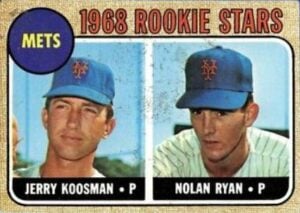
1960s: 1968 Topps Nolan Ryan/Jerry Koosman #177 Rookie Card
Highest sale price: $600,000
1970s: 1975 Topps George Brett #228 Rookie Card
Highest sale price: $158,600

1980s: 1989 Upper Deck Ken Griffey Jr. #1 Rookie Card
Highest sale price: $6,600

1990s: 1993 SP Derek Jeter #279 Rookie Card
Highest sale price: $468,000

2000s: 2001 Topps Traded Albert Pujols #T247 Rookie Card
Highest sale price: $4,105

2010s: 2011 Topps Update Mike Trout Rookie Card
Highest sale price: $6,365

2020s: 2024 Topps Chrome Update Paul Skenes Rookie Debut Patch Autograph 1/1
Highest sale price: $1,110,000

The Pujols Card Is the Sleeper on This List
Of all seven cards, the one I keep coming back to is the 2001 Topps Traded Albert Pujols rookie. Part of what makes it so compelling is that Pujols wasn’t expected to be a factor for the St. Louis Cardinals when he reported to spring training in 2001, but he played so well that he made the Opening Day roster. And the rest, as they say, is history.
Since he wasn’t expected to be in the big leagues, this meant the 2001 National League Rookie of the Year wasn’t included in the base 2001 Topps set. So, his flagship rookie only exists because of the Traded set. It was typically an afterthought product that suddenly became one of the most important Pujols cards in existence once the world figured out what was happening with the right-handed slugger.
Throw in the dark green border, and you’ve got a card with a naturally low PSA 10 population. Only 7,208 have been graded across the entire universal population, per Solow. That’s a fraction of what you’d see for Griffey or Trout. The scarcity is real, and it’s a big reason why this card jumps out to me from this specific list.
The Genuinely Insane Start to Albert Pujols’ MLB Career
To fully appreciate what his rookie card represents, it’s worth understanding just how incredible the start of Pujols’ career was. I’ve written about it before, but I don’t mind repeating myself because the numbers were just that nuts.
From 2001-10, Pujols hit .331 with 408 home runs, 1,230 RBI, and an 81.4 bWAR. He put up 10 seasons of 30-plus homers and 100-plus RBI with a .300 average during this stretch. It’s something only four players have ever done, alongside Babe Ruth, Lou Gehrig, and Manny Ramirez.
However, Pujols is the only one of the four to do it consecutively and at the start of his career. An average season during this stretch included 41 homers, 43 doubles, 123 RBI, and 119 runs scored.
Pujols’ initial run with the Cardinals was the foundation of what will surely be a first-ballot Hall of Fame career. In addition to winning the 2001 NL Rookie of the Year, The Machine also took home three MVP awards, six Silver Sluggers, two World Series rings, and is fourth on MLB’s all-time home run list with 703 taters. That Topps Traded rookie card is a time capsule for one of the most dominant careers the sport has ever produced.
How the Hobby Got Here: Cards Then vs. Now
One thing this list really drives home is how much the collecting world has shifted over the decades. Back when the Ryan/Koosman rookie hit shelves, kids were buying packs for the gum. The idea that a piece of cardboard could sell for $600,000 would’ve gotten you laughed out of the room.
The 1989 Upper Deck Griffey card was a turning point, though. It was the first time a card company made the product itself feel premium thanks to glossy stock, clean photography, and serial-numbered subsets. Collectors started paying attention to the card as an object, not just the player on the front.
That shift opened the door to everything that followed: the foil-surfaced Jeter SP in the ’90s, the auto and relic boom of the 2000s, and eventually the one-of-one mania that led to the Paul Skenes Rookie Debut Patch Auto selling for over $1 million.
Today, the hobby blends nostalgia with investment logic in a way that didn’t exist decades ago. Collectors track PSA populations, monitor auction results on CardLadder, and make calculated bets on long-term player value. But that’s all part of the thrill when it comes to the chase, right?
Love home runs? Sign up for my Substack today and start getting interesting home run-related observations straight to your inbox! And if you’re new to MLB Daily Dingers, it’s probably best to start here.