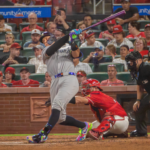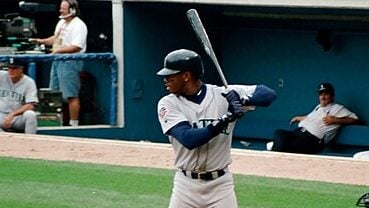
Ken Griffey Jr. baseball cards have consistently ranked among the most valuable pieces of cardboard in the hobby. There’s a good reason for that, too — Junior was a generational talent who went on an unbelievable tear with the Seattle Mariners through the first decade of his Hall of Fame career.
It didn’t hurt that he brought all the swag with him to the park every day. Between the swing, his backward cap, and the effortless joy, nobody made baseball look as cool as him during the ’90s, and a whole generation of baseball fans who watched him do it — like yours truly — will never forget it, either.
Sports Illustrated’s David Solow recently put together a breakdown of five valuable Griffey cards, and the numbers might make your eyes twitch. Let’s look at the list before I dive deeper into my favorite of the bunch.
Editor’s Note: Looking to Sell Sports Cards? Here’s How to Do It Quickly & Easily
The Five Cards and Their Eye-Popping Sale Prices
All of the sale prices are from Solow’s piece, and all images are from Card Ladder, unless otherwise noted:
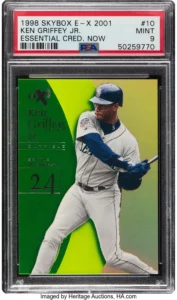
1998 SkyBox E-X 2001 Essential Credentials Now /10 PSA 9: Sold for $280,600 on May 17, 2025.
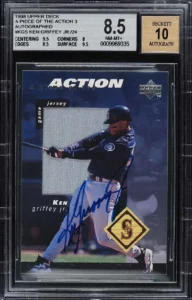
1998 Upper Deck A Piece of Action 3 Patch Auto /24 BGS 8.5: $84,000 (October 21, 2022)
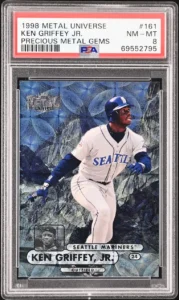
1998 Metal Universe Precious Metal Gems /50 PSA 8: $72,500 (September 15, 2023)
1997 Pinnacle Certified Gold Team Mirror #012: $65,322 (September 26, 2021)

1999 Skybox E-X Century Essential Credentials Now /17 PSA 7: $63,000 (September 26, 2025)

The 1999 Skybox E-X Century Is The One I’d Chase
You can’t go wrong with chasing any one of these cards, but I’m going straight to the bottom of this list for the 1999 Skybox E-X Century Essential Credentials Now, numbered to 17.
What makes this card fascinating is the numbering structure. For the “Now” parallels in this set, the print run matches the player’s base card number. Griffey was #17, so only 17 of these exist. The “Future” version flips the formula (100 minus the card number), giving that parallel a run of 83. It’s a gimmick, but I love it.
The design also doesn’t hurt. Griffey’s iconic backswing is front and center, with his name etched in shiny metallic foil that still looks great, even 25 years later.
This particular copy is a PSA 7. That might sound unimpressive, but it’s hard to see anything specifically wrong with this piece of cardboard. According to Solow, a Craig Biggio version of the same card recently moved for around $250. And just in case you forgot, the above Griffey copy sold for $63,000. That gap tells you everything about where The Kid sits in the hierarchy of 1990s baseball card collecting.
Why Ken Griffey Jr. Baseball Cards Beat the Junk Wax Curse
Griffey’s peak card years squarely overlap with the junk wax era, which is usually a bad thing. This was the late-1980s through mid-1990s period when card companies printed so many copies of everything that most cards became worthless almost overnight. So why are his cards selling for five figures and beyond?
The inserts from 1997–99 were a completely different animal from base cards. While companies cranked out millions of base cards, the inserts (like Precious Metal Gems, Essential Credentials, and Mirror Golds) were deliberately manufactured in small quantities. That scarcity was intentional, and it held up.
Griffey’s resume is also untouchable. The first-ballot Hall of Famer retired with 630 home runs, 10 Gold Gloves, 13 All-Star appearances, and 7 Silver Sluggers. More importantly, he put those numbers together during baseball’s steroid era while never being connected to performance-enhancing drugs. That distinction matters a lot to collectors, and it always will. You’re not buying a cloud of controversy when you buy a Griffey. You’re buying a genuine legend.
Finally, it’s worth noting that Griffey’s impact on baseball went beyond the diamond itself. He was a pop culture figure, and his era-defining personality was featured in video games and endorsements. That kind of cultural footprint keeps demand alive for decades, as we can see!
So, Which One Would You Actually Chase?
Look, if money were no object, the answer is obvious — you go after the 1998 SkyBox E-X 2001 Essential Credentials Now, the crown jewel of the Griffey cardboard universe. Only 10 copies exist, and the PSA 9 on this particular card is the highest-graded copy. It has Griffey’s Mariners green built right into the design. It’s the best of everything (scarcity, aesthetics, provenance) wrapped into one hard-to-find card.
But if we have to get more realistic, the question becomes which card offers the most bang for an impossible buck. And I keep coming back to that 1999 E-X Century. It feels like the kind of card that’s slightly overlooked, which means the ceiling might be higher than that $63,000 sale suggests. Time will tell.
Love home runs? Sign up for my Substack today and start getting interesting home run-related observations straight to your inbox! And if you’re new to MLB Daily Dingers, it’s probably best to start here.