There’s a unique place in the hobby for Mickey Mantle baseball cards. In many cases, even mid-grade copies of his most iconic issues can send budgets into a tailspin.
While that can be frustrating for most collectors, it’s worth noting that owning a piece of The Mick doesn’t have to include taking out a second mortgage.
Sports Illustrated’s Russ Gioseffi recently highlighted five Mantle cards that people can buy for less than $500. Let’s check out those options and the details that led to these lower prices, along with some thoughts on why affordable Mantles can be both a blessing and a bit of a contradiction.
Editor’s Note: Looking to Sell Sports Cards? Here’s How to Do It Quickly & Easily
5 Affordable Mickey Mantle Baseball Cards Worth Grabbing
According to Gioseffi’s research, these five cards deliver solid Mantle ownership without destroying your wallet. All price/condition information is from Gioseffi, while the images are via Sports Cards Pro:
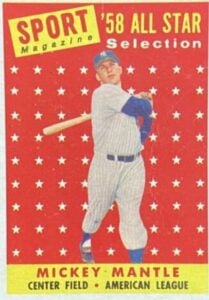
1958 Topps All-Star #487: Mantle finishing his swing in pinstripes with that classic All-Star design. A PSA 5 runs around $300.

1958 Topps World Series Batting Foes #418: Mantle and Hank Aaron sharing the same cardboard is always a must-see event. An SGC 5 is around $400.

1959 Topps #10: Bold red circle and sharp color with Mantle’s smirk featured prominently. A PSA 3 comes in around $400.

1960 Topps #350: A horizontal design featuring both Mantle’s batting stance and portrait. Grades from PSA 2 to 4.5 can be found under $500.

1969 Topps #500: His final Topps card, with his complete career stats on the back. A PSA 4 lands around $350.
Why the 1958 Topps Batting Foes Is My Crown Jewel of This List
If I’m only picking one card off this list, the 1958 Topps World Series Batting Foes is the one I’m grabbing, and it’s not particularly close.
Just think about what this card represents. We have two legendary sluggers still early in their careers (both were in their mid-20s). They’re seen as two of the biggest offensive threats of their era at that time, and people had no idea what was actually in store for them by the time their careers were over. Mantle and Aaron ended up being two of baseball’s most prolific sluggers ever, combining for 1,291 total homers (536 for Mantle, 755 for Aaron).
This is also great because of the context of the 1958 World Series, which had the New York Yankees and Milwaukee Braves facing off. It captures a real moment of baseball history (not something completely staged) with two legends in their prime.
‘Affordable Mickey Mantle Cards’ Is Kind of an Oxymoron
Let it also be known that the phrase “affordable Mickey Mantle cards” is doing some work here. Sub-$500 is quite accessible compared to where Mantle’s top-tier cards trade, but it’s still $300 to $500 for a single card that grades out somewhere between a 3 and a 5.
Mantle’s legacy in the hobby is almost unmatched, though. He’s the gold standard for mid-century cards, and prices at every grade reflect that. The 1952 Topps PSA 8 sale made national headlines, but the demand for even his more common issues never really softens.
There’s always someone who wants to own a piece of The Mick (understandably so!), which keeps the floor high across the board.
So, yeah — this list exists in a world where $400 is considered the budget option, but that’s just the reality of Mantle cards. The good news is that the five pieces of cardboard highlighted above are all worth owning.
The Case for Low-Grade Vintage When Completing a Collection
For set builders working on 1958 or 1959 Topps, the goal is to fill every slot in the binder. A lower-grade Mantle scratches that itch at a fraction of the cost of a higher-grade copy, and if we’re being honest, a PSA 3 from 1959 has earned its wear. These cards are nearly 70 years old, ya know.
Lower-grade vintage also opens the door for collectors who want to handle and appreciate the card rather than keep it purely as an investment. There’s something to be said for owning a raw or low-graded Mantle that you can actually look at. The physical/tangible connection to a card from that era is part of what makes vintage collecting special in the first place.
Love home runs? Sign up for my Substack today and start getting interesting home run-related observations straight to your inbox! And if you’re new to MLB Daily Dingers, it’s probably best to start here.