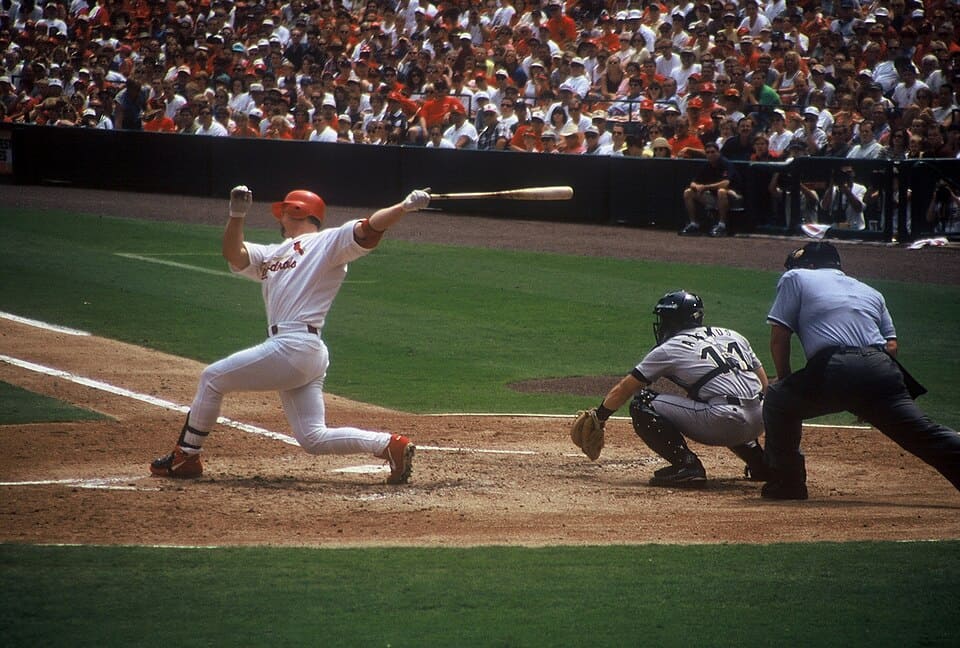
Mark McGwire hit his 21st home run of the season on May 22, 1998. It was a 425-foot blast off Mark Gardner in the sixth inning at Busch Stadium, but there was something a little more unique about it.
The ball landed in the section of the upper deck in left field that had been named after him. Big Mac Land, meet Big Mac. All fans in attendance went home with a coupon for a free Big Mac from McDonald’s. Some free food and getting to see a tank off the bat of McGwire? Not a bad night at the ballpark.
Related: A Complete Guide to Single-Season (& Single-Game) HR Performances
A Deeper Dive Into What Big Mac Land Was

The St. Louis Cardinals teamed up with McDonald’s ahead of the 1998 season to designate a section of seats in the left-field upper deck at Busch Stadium as Big Mac Land. The deal was simple: any time McGwire hit a ball into that section, every fan with a ticket got a free Big Mac.
The irony that made the moment even better is that McGwire told reporters after the game he’d never eaten a Big Mac in his life. “I’ve never had one in my whole life,” he said, via CBS News. “I’ve never touched one. I don’t like that special sauce and all the other stuff.” The man the promotion was named after wanted no part of the product. Can you imagine sharing a nickname with a famous food, and you’ve never even tried it (or had the desire to)? Bummer, man.
The 425-foot shot that triggered the promotion was actually described as “short” for McGwire. CBS noted that Big Mac was averaging 414 feet per homer at the time, and his previous five home runs had traveled 451, 471, 440, 478, and a Busch Stadium-record 545 feet.
Revisiting Mark McGwire’s Historic 1998 Campaign
McGwire opened the 1998 season with a grand slam on Opening Day and hit three more over his next three games. He had already slugged 11 homers by the end of April, and his Big Mac Land tater was just a footnote in what was the most powerful month of his historic year.
That homer was one of 16 (!) McGwire slugged during May. It was accompanied by 32 RBI, 25 runs scored, and a ridiculous .326/.513/.907 triple slash. I mean, you know you’re on track to do special things in the power department when you’re approaching 30 homers before the calendar even flips to June.
McGwire posted five different months of double-digit homers in 1998. The only time he didn’t slug 10 or more in a calendar month was July, when he had to settle for “just” eight homers. McGwire posted a .956 OPS that month, which was the only time his monthly OPS dipped below 1.150.
The home run chase that summer was one of the great cultural moments in baseball history. McGwire and Sammy Sosa (who finished the season with 66 homers) going back and forth each night captivated a sport that was still recovering from the 1994 players’ strike. As a kid, I loved waking up every morning and running to the TV so I could turn on SportsCenter as fast as possible to see what happened the day before. Simpler times, right?
Although Sosa beat out McGwire for National League MVP Award honors, Big Mac finished with a record-breaking 70 homers, 147 RBI, 130 runs scored, and a .299/.470/.752 line.
The Cloud That Will Forever Follow McGwire’s Legacy
McGwire admitted to steroid use in 2010, confirming what many had long suspected. He said he used them for health reasons, to recover from injuries, and expressed regret for how things unfolded. His Hall of Fame case stalled and eventually ran its course without induction — he peaked at 23.7% of the vote in 2010. Support unsurprisingly cratered from there. His final year on the ballot in 2016 resulted in getting just 12.3% of the vote.
But what’s hard to fully dismiss is that whatever your opinion is of McGwire and his 70-homer barrage, the 1998 season gave baseball something it desperately needed. He and Sosa brought the sport back into living rooms and sports sections it had lost. There’s a version of the story where that season saved baseball’s relationship with casual fans.
While McGwire and his 583 career home runs will likely never find a spot in Cooperstown, it’s hard to discount the kind of impact he had on the game thanks to this one legendary campaign.
Love home runs? Grab the free MLB Home Run Almanac — all-time, single-season, and postseason leaders for all 30 franchises — and get home run history/blog updates delivered to your inbox twice a week.