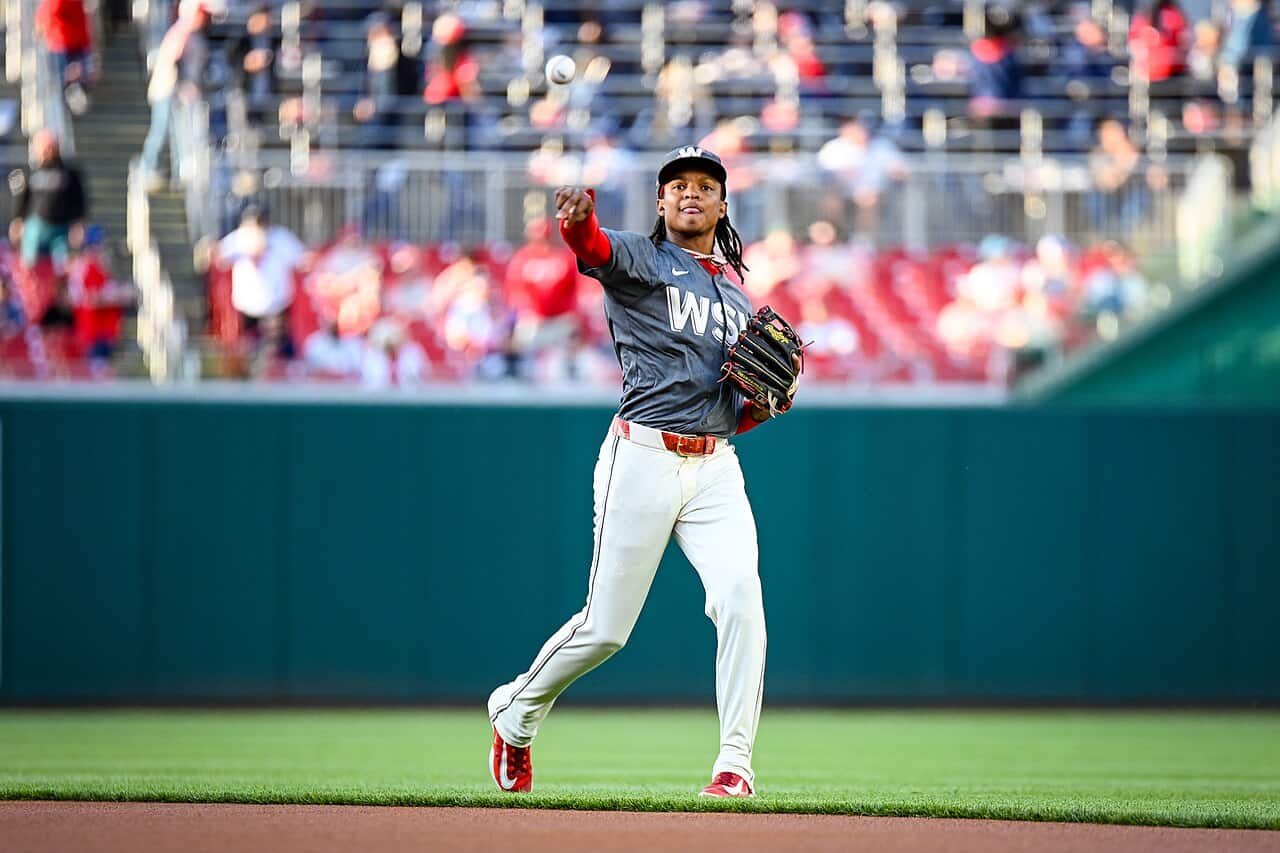
CJ Abrams is enjoying a season that no shortstop in Washington Nationals history has ever had. His 27th home run of the year not only extended what’s been a career-best campaign, but it also broke a franchise record for the position.
It’s a reminder of just how far shortstop offense has come from the days when the job was strictly about playing defense.
It’s a lineage that runs through Cal Ripken Jr., who is credited with proving a shortstop could be a legitimate offensive force. But long before Ripken made his impact, Chicago Cubs legend Ernie Banks was already doing it while quietly making the case that a shortstop could hit like a middle-of-the-order slugger.
Abrams’ record-setting year is as good a moment as any to look back at how we got here, and how much further the position’s ceiling might still go.
Related: A Complete Guide to Single-Season (& Single-Game) HR Performances
A Career Year, and a Franchise Record, for CJ Abrams

Abrams is putting together the best season of his career, and it’s not particularly close. Through 109 games in 2026, he’s already hit a career-high 28 home runs. That easily surpassed his previous career high of 20 in 2024, as well as the 19 he slugged through 144 games in 2025. He’s among the best power hitters in the National League and is right behind teammate James Wood, according to FanGraphs.
Breaking Desmond’s franchise shortstop record took place during a two-homer performance against the Arizona Diamondbacks on July 26. That enabled Abrams to pass Desmond’s record of 25 homers, which he set in 2012.
While the Nationals don’t appear to be a legitimate postseason contender (anything can happen over the next couple of months, though), Abrams is a crucial cog in what’s become a potent and young Nationals lineup. The 25-year-old earned his second career All-Star Game selection this season, while his OPS sits at .917 to go along with a league-leading 85 RBI through 466 plate appearances.
It’s worth noting that this is the first time Abrams will finish a season with more than 65 RBI.
Before Ripken, There Was Mr. Cub
Being an MLB shortstop means something very different today compared to what it used to mean. In previous eras, players at this position weren’t exactly known for their offensive capabilities. Hitting homers and being a legitimate force in the middle of their team’s lineup was far from the minds of many.
Cal Ripken Jr., baseball’s Iron Man, is widely considered the man who “revolutionized” the shortstop position. The 6-foot, 4-inch Hall of Famer showed that someone of his size could excel on both sides of the ball for an extended period.
Chicago Cubs legend Ernie Banks wasn’t quite as tall as Ripken (he was 6-foot, 1-inch), but he showed that a shortstop could provide plenty of offense well before Ripken paved the way for guys like Derek Jeter, Nomar Garciaparra, Alex Rodriguez, and that amazing era of shortstops in the 1990s and early 2000s that all of us millennials think about constantly.
Is Ernie Banks Remembered More as a Shortstop or a First Baseman?
Banks made his debut in the big leagues as a 22-year-old during the 1953 season. He spent most of his first nine seasons as the Cubs’ shortstop. However, playing that position became too tough for the 30-year-old due to a knee injury he suffered while serving in the army.
He played in 104 games as a shortstop during the 1961 campaign and also played left field for 23 games before trying out first base. That’s pretty much where he stayed until the end of his Hall of Fame career in 1971.
As it turns out, Banks appeared in more big-league games as a first baseman (1,259) than as a shortstop (1,125). But before he made that permanent position switch, the right-handed slugger made sure to bring the noise and the funk consistently on the left side of the infield.
Revisiting Mr. Cub’s Incredible Run from 1957 to 1960
It was hard to find someone as consistently dominant as Banks during these four seasons.
He suited up for at least 154 games in each campaign. Banks also surpassed the 40-homer plateau five times as a big leaguer, but four of those seasons came during this span (1957-60).
Mr. Cub led the league in homers (47), RBI (129), slugging percentage (.614), and total bases (379) in ’58 on his way to winning his first MVP Award. He didn’t lead the league in homers the following year (he hit 45), but led the way in RBI again (143) while winning another MVP. He capped off this run by finishing fourth in the 1960 MVP Award voting but led the way in homers (41) while winning his first (and only) Gold Glove Award.
Overall, an average year from Banks during this four-season stretch included a .293/.362/.586 line with 44 homers, 29 doubles, 123 RBI, and 106 runs scored — all while playing just about every day at one of the sport’s toughest positions.
Nobody hit more homers (176) or drove in more runs (491) than Mr. Cub during this time, per FanGraphs. Hank Aaron ranked second in both (153 homers and 476 RBI). There were also only three players with 30.0-plus fWAR during this time: Willie Mays (33.9, an outfielder), Mickey Mantle (33.7, an outfielder), and Banks (31.6, a shortstop).
How Far Abrams Still Has to Go
As impressive as Abrams’ season has been, it’s worth putting it in perspective against the true offensive ceiling for the position. The single-season home run record for a shortstop belongs to Alex Rodriguez, who hit 57 home runs for the Texas Rangers in 2002. Although A-Rod’s time in Texas was tainted by his admitted usage of performance-enhancing drugs, it’s still one of the most jaw-dropping power seasons ever by a middle infielder.
Abrams has a couple of months to see what new heights he can get to in the home run department this year, but he won’t get all that close to Rodriguez’s record. That’s not a knock on what Abrams has accomplished thus far, though. It’s just a reminder of how ridiculous a number that is for a shortstop to produce…in any era.
Banks proved a shortstop could hit like a middle-of-the-order bat. Ripken proved that size and shortstop defense weren’t mutually exclusive. Rodriguez pushed the power ceiling somewhere nobody else has matched. And now Abrams, at 25 years old and just hitting his stride, is the latest reminder that premium offense can be accompanied by a player manning that area of the diamond.
Enjoyed this one? Sign up for the Bases Loaded Bulletin — my monthly print newsletter — for deep dives like this delivered straight to your mailbox. Or grab a copy of The Power Kings for the full story of every MLB franchise’s greatest home run seasons.