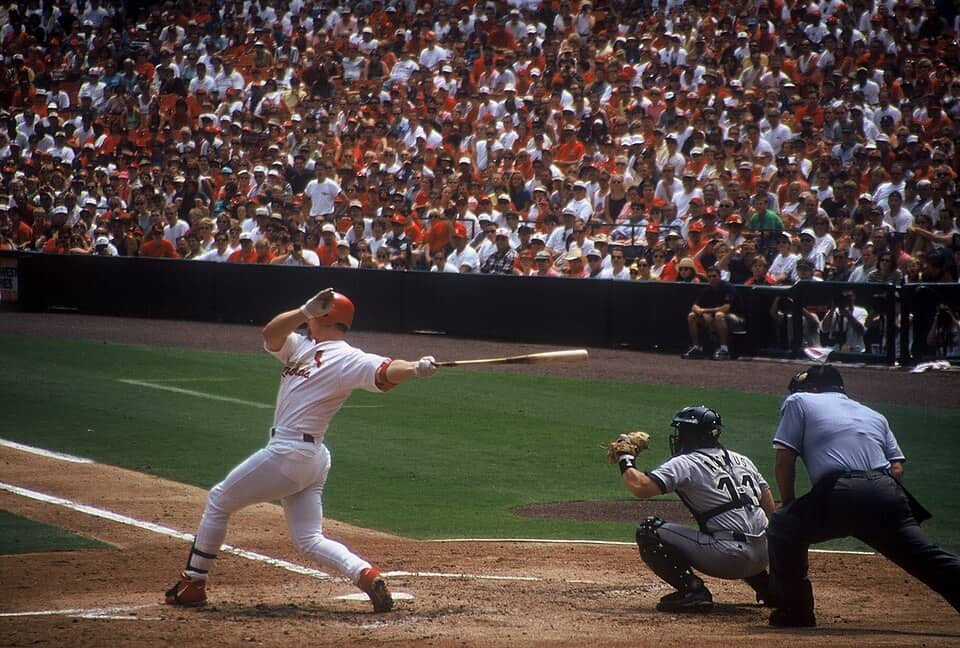
Bringing up Mark McGwire has the potential to cause some strong reactions because of his use of performance-enhancing drugs. And even if some fans got their wish by having his stats accompanied by an asterisk, those gaudy numbers aren’t going anywhere.
So, that means I’m going to talk about them, which is good because what he did in the latter portion of the 1990s was insane.
Most people know the counting stats by heart — 70 homers in ’98, another 65 taters in ’99 — but there’s a specific number buried in his four-year run between 1996 and 1999 that still stops me in my tracks every time I look at it.
New here? Download the MLB Home Run Almanac for free — all-time, single-season, and postseason leaders for all 30 franchises, updated through 2025. Grab your copy here.
Revisiting Mark McGwire’s Historic 4-Year Power Surge

The back half of the 1990s produced some of the most absurd power numbers in league history, but nobody’s four-year stretch looked quite like McGwire’s.
Even before Big Mac started reaching the 50-homer plateau like it was nothing, he had established himself as one of the game’s premier power hitters. His 49 homers as a rookie in 1987 were an MLB record until Aaron Judge broke it in 2017 with 52 home runs of his own.
Big Mac proceeded to post five more seasons of at least 30 homers between 1988 and 1995. But what he did between 1996 and 1999 was outrageous in multiple ways. I’ll start with the most obvious one before getting to the more obscure stats.
The right-handed slugger led the league in homers three times during this span (52 in 1996, 70 in 1998, and 65 in 1999). His 245 total home runs were the most in baseball (Ken Griffey Jr. was second at 209).
An average year for McGwire looked quite ridiculous, too. It included a .290/.437/.704 line with 61 (!) homers, 133 (!!) RBI, and 110 runs scored. That’s what he averaged! Very few players in MLB history have ever hit 61 homers in a single season, let alone posted that as a four-year average.
He surpassed the 50-homer mark in each campaign, becoming the first MLB slugger to accomplish that feat. To this day, more than 25 years later, the only other dude to also do it was Sammy Sosa. His streak took place from 1998 through 2001. It nearly included a fifth consecutive year, but he finished his 2002 campaign with a league-leading 49 homers.
Even with the recent power surge across the league — juiced balls, launch angles, the works — nobody’s come particularly close to matching what those two did. Modern sluggers have put together monster individual seasons, but stringing together four straight years at this level remains something for many of today’s players to strive for.
Was Hitting a Home Run the Most Likely Outcome for McGwire?
We’ve established that McGwire hit 245 homers from 1996-99. He also collected 90 doubles and one triple (lol). Since he racked up a total of 577 hits, that means Big Mac hit 241 singles.
So, yes — if he put the ball in play, it was officially more likely that McGwire would hit a home run than a single. That just makes me laugh.
This type of ratio nearly followed him his entire career (sort of). Here’s a breakdown of McGwire’s career hit numbers:
- Total hits: 1,626
- Singles: 785
- Doubles: 252
- Triples: 6
- Home Runs: 583
If we tally up the doubles, triples, and homers, that gives him 841 extra-base hits. So whenever McGwire put the ball in play during his 16-year big-league career, the chances of it going for extra bases were better than it being a simple single.
That’s what makes his four-year peak from 1996-99 so wild. It took a career-long extra-base rate that already leaned heavily toward power and pushed it to another level. One where a home run was genuinely more likely than the most common type of hit in baseball.
Enjoyed this one? Sign up for the Bases Loaded Bulletin — my monthly print newsletter — for deep dives like this delivered straight to your mailbox. Or grab a copy of The Power Kings for the full story of every MLB franchise’s greatest home run seasons.