Twenty-two MLB players hit at least 30 home runs in 2026, the fewest in a full season this decade. But two of them, Colson Montgomery and Manny Machado, joined that club while finishing as below-average hitters, according to wRC+.
I feel like we typically associate someone hitting 30 home runs with having an elite year at the dish, so this probably sounds weird. And sure, it’s the floor for a big power season, but there’s more that goes into a player’s overall offensive value.
So, let’s chat about 2026’s 30-homer club, including who made it, how it compares to recent seasons, and why Montgomery and Machado are being singled out.
Editor’s Note: My Newsletter Subscribers saw this before anyone else did. Subscribe today to get the best home run content straight to your inbox.
How Many Players Hit 30 Home Runs in 2026?
Among players with at least 200 plate appearances during the 2026 MLB season, 22 reached the 30-homer plateau.
And while nobody reached 50 taters this year, the group includes eight guys who distinguished themselves by hitting at least 40: Kyle Schwarber (45), Pete Crow-Armstrong (45), Pete Alonso (43), Yordan Alvarez (42), Junior Caminero (42), Matt Olson (41), Ben Rice (41), and Hunter Goodman (41).
The rest of the players in the 30-homer club include the following sluggers:
- Rafael Devers: 37
- Brandon Lowe: 35
- Munetaka Murakami: 35
- Miguel Vargas: 33
- CJ Abrams: 33
- Kazuma Okamoto: 33
- Sal Stewart: 32
- Colson Montgomery: 31
- Nolan Arenado: 30
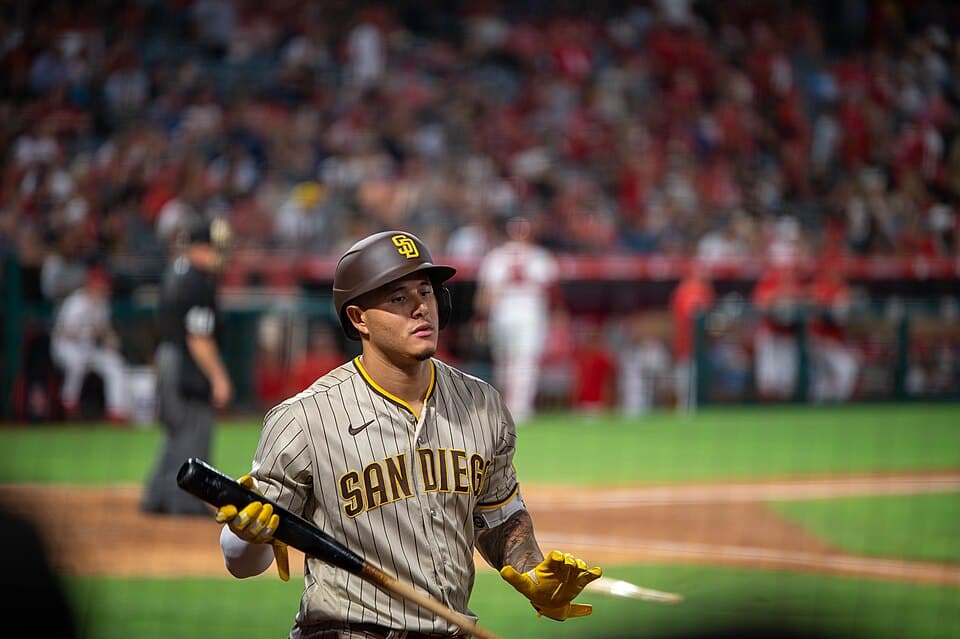
- Manny Machado: 30
- Shohei Ohtani: 30
- Luis Garcia Jr.: 30
- Elly De La Cruz: 30
- James Wood: 30
So, how does this compare to 2025? It’s actually a stark contrast to the prior season, which boasted 33 dudes who slugged at least 30 home runs. And as it turns out, this is the fewest 30-homer hitters we’ve seen during one season so far this decade (not including the shortened 2020 season, of course).
Here’s a quick look at the number of players in this group each year between 2021 and 2025:
- 2021: 43 players
- 2022: 23 players
- 2023: 29 players
- 2024: 23 players
- 2025: 33 players
If things bounce back similar to 2023 and 2025, the 2027 season is bound to have an increase (assuming we have a mostly full regular-season schedule, that is).
How I Determined the ‘Below Average’ 30-Homer Hitters
While we sometimes rag on players at different parts of the season, every hardcore baseball fan knows just how hard it is to play this game, especially in the majors.
Hitting one big-league homer is impressive. So is hitting two, 10, and 20. When players reach 30-plus, the numbers tell us we’re in special territory. But still, there are occasions where players can find themselves in an exclusive group like this while technically not being an above-average offensive producer.
As mentioned above, the barometer I’m using to determine this is wRC+. This metric rolls a hitter’s total offensive value into one number, adjusted for ballpark and league, and 100 is average.
The 2 Players in This Group That Stick Out

So, using this logic, two players in 2026’s 30-homer club had a below-average offensive value because they failed to finish with a wRC+ of at least 100.
Those dudes are Chicago White Sox shortstop Colson Montgomery (91 wRC+) and San Diego Padres third baseman Manny Machado (98 wRC+).
What I also found interesting about these two being together is that they arrived there in different ways.
For Montgomery, it was a tough second half that took him down this road. He posted an .840 OPS with 21 home runs through 71 games as a 25-year-old rookie in 2025. And while he slugged 31 homers with 87 RBI for Chicago in 153 games in 2026, his OPS dropped to .685 while also breaking MLB’s single-season strikeout record with 227 whiffs.
In the first half, he posted a .771 OPS with 23 homers, 53 RBI, and 121 strikeouts in 91 games. But in the 62 games he played following the All-Star break, those numbers dropped to a .557 OPS with eight home runs, 34 RBI, and 106 strikeouts.
It was the opposite story for Machado, who had a slow start and spent most of his year trying to dig himself out of that hole. He only posted a monthly OPS higher than .800 once (.921 in July), but the worst of it came within the first couple of months.
The veteran posted a .714 OPS through his first 28 games of the season, and followed that with a .525 mark in 28 games in May. Things got better in June (.778 OPS) and July, but then he rode the roller coaster down in August (.631 OPS) and September (.706).
It’s the first time Machado posted a below-average wRC+ in a full season as a big leaguer. The only other time he did it was in 2012, when he finished with a 97 wRC+ through 51 games as a 19-year-old rookie for the Baltimore Orioles.
How Many ‘Below Average’ 30-Homer Seasons Have There Been Since 2021?
Naturally, after seeing just two guys within this group post a wRC+ below 100, I wondered how often it’s happened over the previous five seasons leading up to 2026.
It’s not all that common, and Montgomery’s 91 nearly ranks as the lowest of the bunch. Here’s a look at the “below average” 30-homer seasons since 2021:
- 2021: Kyle Seager (35 home runs, 98 wRC+), Eugenio Suarez (31 home runs, 85 wRC+), Adolis Garcia (31 home runs, 99 wRC+)
- 2022: None
- 2023: None
- 2024: None
- 2025: Salvador Perez (30 home runs, 95 wRC+)
I talk a lot about players distinguishing themselves within a group they’ve already joined. It doesn’t usually happen in this manner, though.
Odds are that they both rebound in 2027 and get back over the century mark in wRC+. Machado has the track record to look back on, while Montgomery has the benefit of being young and using this experience to get better moving forward.
But we’ll have to wait and see if that happens.
Love home runs? Sign up for the Bases Loaded Bulletin today to get the best home run content straight to your inbox! And if you’re new to MLB Daily Dingers, it’s probably best to start here.