I played first base from about fourth grade through college. So, when I was a young and impressionable baseball fan, I gravitated toward MLB first basemen I admired and wanted to be like.
A few of those guys included John Olerud, Derrek Lee, Doug Mientkiewicz, and… Rafael Palmeiro.
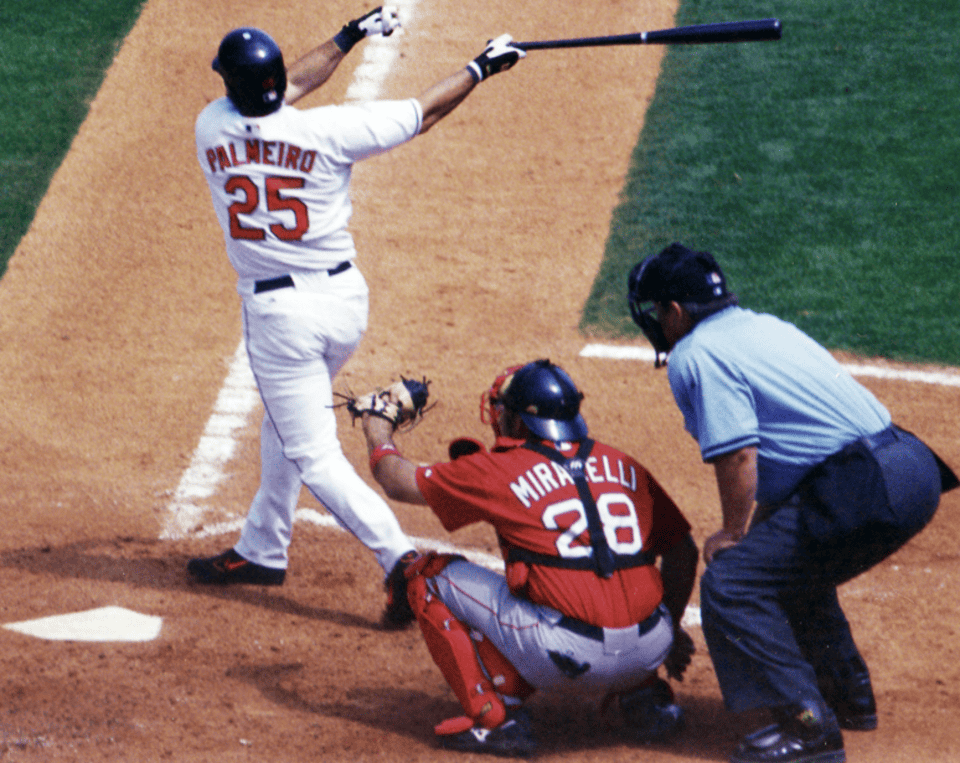
I loved every bit of Palmeiro’s game. He had a sweet left-handed swing, he’s one of seven hitters in the 3,000-hit/500-homer club, and he played good enough defense to win three Gold Glove Awards (even though he was primarily a designated hitter when he won the honor in 1999).
Palmeiro’s late-career power surge in the late 1990s and early 2000s is something I marveled at throughout middle school and high school. But then came his testimony in front of Congress, the failed drug test a few weeks later, and a legacy that will forever be tainted.
Editor’s Note: Sign up for the Bases Loaded Bulletin — my monthly print newsletter — for deep dives like this delivered straight to your mailbox. Or grab a copy of The Power Kings for the full story of every MLB franchise’s greatest home run seasons.
Looking Deeper at Raffy’s Late-Career Home Run Binge

When looking at Palmeiro’s Baseball-Reference page, there’s a very clear divide between the first half and second half of his career when it comes to power production.
He made his big-league debut in 1986 as a 21-year-old with the Chicago Cubs. Over the first nine years of his career (through 1994), he registered just one 30-homer season (37 in 1993). But over his final 11 seasons (from age 30–40), he surpassed the 30-homer plateau nine times. This included four campaigns of at least 40 taters.
Here’s a quick look at how his numbers between these two periods differed:
- 1986–94: .298/.364/.480, 155 homers, 266 doubles, 602 RBI, and 669 runs scored
- 1995–05: .282/.375/.539, 414 homers, 313 doubles, 1,233 RBI, and 993 runs scored
A typical year in the power department for Palmeiro went from averaging 17 homers, 30 doubles, and 67 RBI to averaging 38 homers, 29 doubles, and 112 RBI between these two periods.
One Potential Defense to a Suspicious-Looking Trend
Watching someone reach a new level in the power department after turning 30 will always lead to suspicion from the masses. Both eyebrows are likely to be raised when that curiously timed power binge also lines up with the height of the steroid era.
But as we can see from the above bullet points, it’s not like Palmeiro wasn’t already a good hitter. We assume a player’s physical prime happens anywhere between the ages of 27 and 32, and Palmeiro’s rise in power production coincides with that.
His single-season career-high mark in homers was 14 through his first five years. He then registered four straight 20-homer campaigns from 1991–94. So, there was a slow build-up before he started cranking 30-plus homers every year.
But then…any credibility he built up came crashing down in 2005.
Watching a Legacy Get Destroyed in Real Time
Palmeiro — along with a bunch of other MLB sluggers — appeared before Congress in March 2005. That’s when the left-handed hitter famously pointed his finger at the committee while emphatically stating that he never used steroids.
He tested positive for stanozolol in May 2005, and despite challenging the result, he eventually served a (very weak) 10-day suspension that August. While he didn’t miss much time on the field, the damage was done.
He hit .266/.339/.447 with 18 homers and 60 RBI as a 40-year-old with the Baltimore Orioles. Even though he wanted to continue his career, he couldn’t find a job. And while his numbers scream that he’s a slam-dunk Hall of Famer, he never came close.
Palmeiro was on the BBWAA Hall of Fame ballot for five years. He never earned more than 12.6% of the vote and fell off the ballot in 2014 after failing to reach the 5% threshold. Raffy appeared on the 2023 Veterans Committee ballot but received fewer than four votes (12 votes were needed to get inducted).
Where Palmeiro Stands in Baseball’s Most Exclusive Club
Here’s what makes the whole situation sting even more: Palmeiro isn’t just a guy with a nice career line. He’s one of only seven players in MLB history to reach both 3,000 hits and 500 home runs, joining Hank Aaron, Willie Mays, Eddie Murray, Alex Rodriguez, Albert Pujols, and Miguel Cabrera in that group.
Look at where the other six landed. Aaron and Mays were first-ballot Hall of Famers. Murray got in on his first try, too. Pujols will be a no-doubt selection whenever he’s eligible, and Cabrera should be right there with him. That leaves Palmeiro and Rodriguez as the only two members of this seven-man club not in Cooperstown, and it’s happening for the same reason.
Rodriguez, for what it’s worth, is still trying to chip away at it. He pulled 40% of the vote in his fifth year on the 2026 BBWAA ballot, up from 34.3% when he debuted. That’s progress, but nowhere near the 75% threshold Carlos Beltran and Andruw Jones just cleared to achieve baseball immortality. Palmeiro never got remotely close to that kind of momentum during his own five years on the writers’ ballot.
That’s really the whole story in one stat. Five of the seven hitters to ever pair 3,000 hits with 500 homers are either enshrined already or comfortably ticketed for a plaque. Palmeiro is one of the outliers, and it’s not because the numbers weren’t historic. It’s because of what happened in front of a congressional committee, and a few weeks later, in a drug test.
Despite all that, looking back on Palmeiro’s numbers is still a fun activity because of how he arrived at 3,020 hits and 569 homers during his 20-year career. But now, more than two decades since he last suited up in the big leagues, it would’ve been wayyyyyy more fun to revisit it all if things didn’t turn out how they did in 2005.
Enjoyed this one? Sign up for the Bases Loaded Bulletin — my monthly print newsletter — for deep dives like this delivered straight to your mailbox. Or grab a copy of The Power Kings for the full story of every MLB franchise’s greatest home run seasons.