We’re well into the 21st century, but it doesn’t hurt to keep looking back at what the last century brought us, right? And when it comes to the hobby, we all know that baseball card sets from yesteryear are important — especially since card collecting morphed from being tobacco inserts to a multi-billion dollar industry.
Sports Illustrated’s Jason Schwartz recently picked five “essential” 20th-century baseball card sets. I’ll briefly touch on each of his choices before diving deeper into the one card set that’s my favorite. Since I’m a millennial, you probably won’t be surprised by my choice.
Editor’s Note: Looking to Sell Sports Cards? Here’s How to Do It Quickly & Easily
The 20th-Century Baseball Card Sets That Built the Hobby
According to Schwartz, the following five releases were the most influential when it comes to 20th-century card collecting:
- T206 (1909-1911): A tobacco-era masterpiece featuring 524 cards, including the legendary Honus Wagner, Ty Cobb, and Christy Mathewson. The Wagner card alone has sold for millions, making it the “Holy Grail” of baseball cards.
- 1933 Goudey: The first major gum company set that shifted cards away from tobacco. It contained four different Babe Ruth cards, along with Lou Gehrig and Jimmie Foxx. There’s also a cool story about the Nap Lajoie card.
- 1949 Leaf: This was a smaller 98-card set with incredible star power. It featured rookie cards of Jackie Robinson, Satchel Paige, and Larry Doby alongside Joe DiMaggio and Ted Williams.
- 1952 Topps: The set that launched the modern hobby and gave us the legendary Mickey Mantle card. If you have one of these in high grade, you’re essentially holding an investment piece that could change your life.
- 1989 Upper Deck: The premium card revolution began here with glossy stock, holographic security features, and photos that made everything before it look amateur. The most famous card in this release is the Ken Griffey Jr. rookie card at #1.
Why 1989 Upper Deck Changed Everything
Look, I really do love vintage baseball cards and what they represent. There’s something special about holding a piece of cardboard that’s decades old — especially when it’s in high grade. But 1989 Upper Deck represents the moment when baseball cards evolved from kid stuff into legit investments.
These cards weren’t designed for kids to carry in their pockets. They went straight from pack to plastic sleeve. Upper Deck understood that adults would pay premium prices for premium products. They marketed these as collectibles and investments.
The decision to put Ken Griffey Jr. at card #1 before he’d even played a major league game was genius. Upper Deck employee Tom Geideman convinced the company to honor a top prospect rather than an established star. That gamble paid off handsomely.
5 Awesome 1989 Upper Deck Rookie Cards
I’ll start with the obvious before talking about four other awesome rookies from this 800-card set:

Ken Griffey Jr. #1 (Star Rookie): PSA 10 copies are readily available, but they’ve consistently pushed the $5,000 mark. Raw copies can be acquired for an average of $85, while PSA 9s sell in the $400 range.

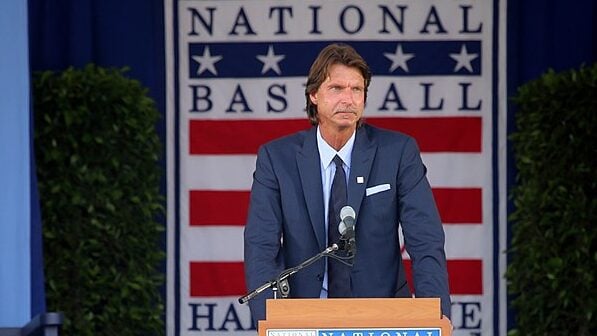
Randy Johnson #25 (Star Rookie): The Big Unit’s first card is great because it shows the Hall of Famer in his Expos gear and before he became a true force on the mound for the Seattle Mariners and Arizona Diamondbacks. PSA 10 copies have recently sold in the $200 range, according to Sports Cards Pro data.

Gary Sheffield #13 (Star Rookie): Here, we get a glimpse of the legendary slugger before he became one of the game’s most feared power hitters during his era. PSA 10 copies typically sell for between $30 and $50.

Craig Biggio #273 (Star Rookie): Another Hall of Famer and a member of the 3,000-hit club, yet Biggio’s rookie sells for just $35 in PSA 10 on average. That’s great value for someone with his on-field credentials and legacy.
The Collecting Legacy That Lives On
What’s fascinating about the five sets Schwartz highlighted is that they each represent a distinct tipping point. The T206 proved cards could outlast the products they promoted. The 1933 Goudey showed moving from tobacco to gum could work commercially. The 1952 Topps established the template every modern manufacturer still follows.
However, 1989 Upper Deck split the hobby into two eras. Pre-Upper Deck cards were made for kids. Post-Upper Deck cards were manufactured with collectors and investors in mind. That shift toward premium products changed baseball card culture.
Which set speaks to you the most? Are you drawn to the vintage artistry of 1933 Goudey or the historical significance of T206? Maybe the nostalgia of 1952 Topps hits different. Or, maybe you’re like me, and you appreciate how 1989 Upper Deck dragged the entire industry into the modern age. Whatever your preference, these five releases represent the foundation that every baseball card collection is built on.
Love home runs? Sign up for my Substack today and start getting interesting home run-related observations straight to your inbox! And if you’re new to MLB Daily Dingers, it’s probably best to start here.