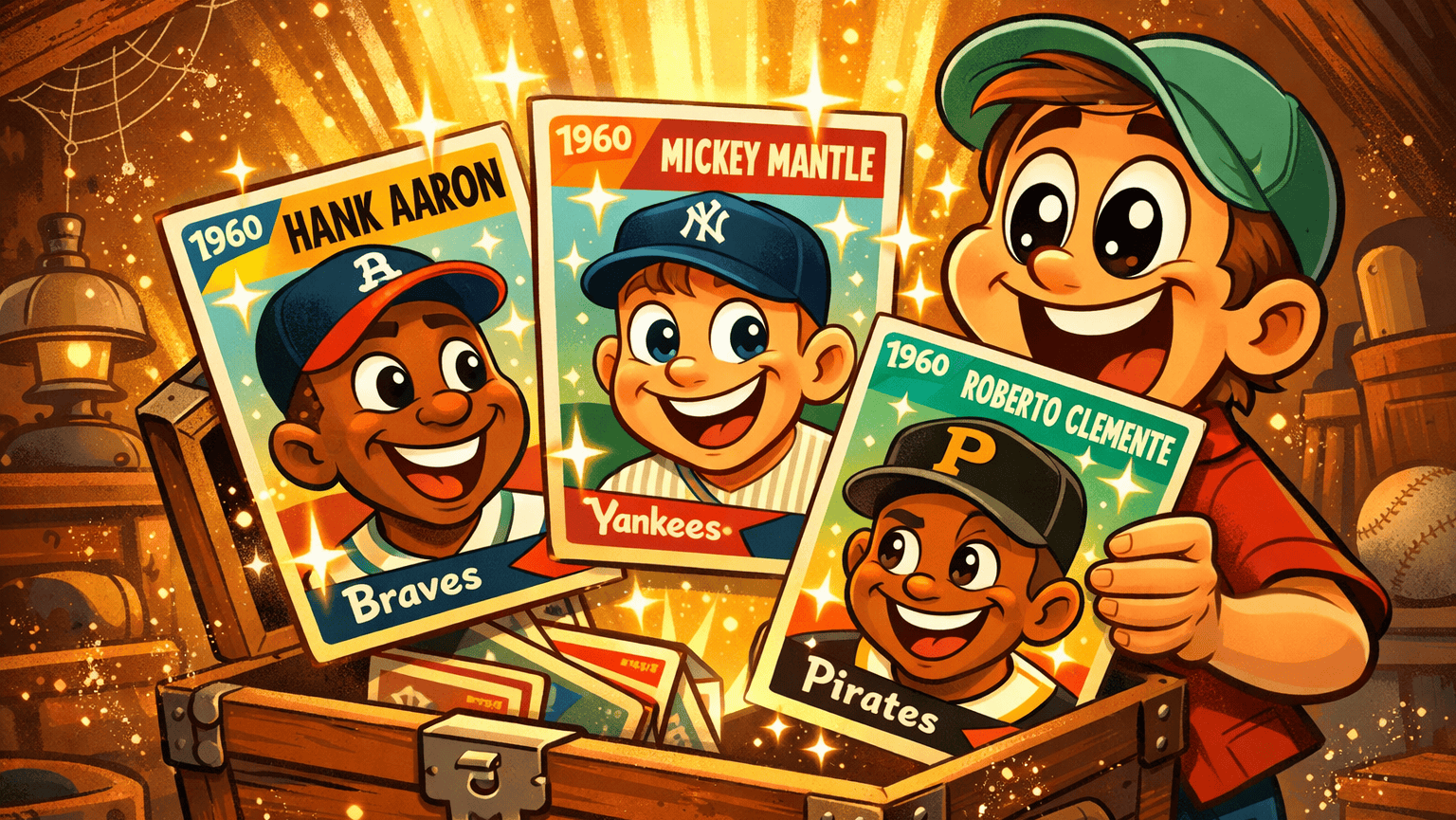
The 1960 Topps baseball cards set is one of the most significant vintage card releases. The 572-card set features an eye-popping roster of Hall of Famers, and it was also the final time Topps used its distinctive horizontal design.
David Gonos of the Happy Hobby Newsletter recently put a spotlight on 10 valuable cards from this set. So, I picked my five favorites from his list to discuss in more detail below.
Editor’s Note: Looking to Sell Sports Cards? Here’s How to Do It Quickly & Easily
5 Must-Have 1960 Topps Baseball Cards For Collectors
Here are five of the 10 cards from the 1960 Topps set Gonos highlighted:
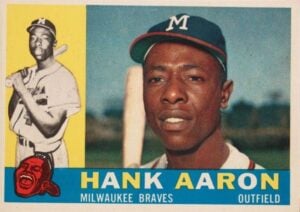
Hank Aaron #300: Aaron’s card features that unique horizontal layout, including two looks at the legendary slugger. Current pricing via Sports Cards Pro data shows PSA 8 examples have been selling for between $3,000 and $5,000.

Mickey Mantle All-Star #563: Part of the Sport Magazine All-Star subset, this high-number card with the “60” background design sold at Heritage Auctions in July 2025 for $3,416.

Roberto Clemente #326: Wait, who’s “Bob” Clemente? Obviously, this wasn’t the Puerto Rican’s preferred first name, which is probably why it’s in high demand among collectors now. It sold for more than $37,000 in 2022 and $19,200 in 2023 in PSA 9 condition (both sales via Heritage).

Bob Gibson #73: A raw version of Gibson’s second-year card might run you less than $50, but a high-grade version will cost a pretty penny. Heritage auctioned off a PSA 9 example in 2024 for $6,900.

Stan Musial #250: Musial’s card offers excellent value at roughly $500-$800 in PSA 8, making it one of the more accessible vintage cards featuring a Hall of Famer from this set.
The Hank Aaron #300: Investment-Grade Vintage
Aaron’s 1960 Topps card captured him at a fascinating time. He was fresh off a 1959 campaign in which he slashed .355/.401/.636 with 39 home runs, 46 doubles, 123 RBI, 116 runs scored, and 223 total hits as a 25-year-old. He finished third in MVP Award voting, which was the fourth straight year in which he placed within the top three.
With the benefit of hindsight, we know that Hammerin’ Hank is one of the best sluggers the game has ever seen. And while he had put together a terrific run between his 1954 debut and that 1959 performance, what collectors didn’t realize at the time was that this was just the beginning.
Between 1960 and 1973, the right-handed hitter averaged a .306/.381/.574 line with 38 homers, 27 doubles, 108 RBI, 103 runs scored, and 15 steals per season. His elite consistency helped him eventually pass Babe Ruth on the all-time home run list and put together one of the most impressive MLB careers we’ve ever seen.
The card’s value reflects both Aaron’s legendary status and the design’s historical significance. High-grade examples in PSA 8 can fetch as much as $5,000, while collectors working with smaller budgets can still own a piece of history with PSA 4-5 copies in the $200-$300 range.
Stan Musial #250: Undervalued Cardinal Legend
Musial’s card offers a Hall of Fame legend at a somewhat reasonable price point, which is rare in vintage collecting. Current market data shows PSA 8 examples selling for less than $1,000, which is much lower than comparable stars from the same era.
Stan The Man was 39 years old once 1960 rolled around. He retired following the 1963 season with 3,630 hits, 475 home runs (the most in Cardinals history), and a .331 lifetime batting average.
The affordability of this card (especially compared to some others highlighted above) makes it an excellent entry point for interested collectors. Lower-grade copies can be acquired for $50-$150, while even top-quality PSA 8 examples stay under $800.
The Legacy of 1960 Topps Baseball Cards
As Gonos noted, the 1960 Topps set marked a transitional moment in the hobby. The horizontal card design made this release instantly recognizable, while the Sport Magazine All-Star subset featuring that distinctive “60” background became one of the set’s most popular features. There are also several important subsets: Rookie Stars (cards #116-146), Baseball Thrills (#461-470), and Sporting News All-Stars (#551-572).
Competition returned when Fleer released an 80-card Ted Williams set, ending Topps’ monopoly after acquiring Bowman. This eventually reshaped the entire industry, but Topps continued its dominance throughout the decade.
From a collecting standpoint, the 1960 set provides excellent depth, with 36 Hall of Fame players featured. Whether you’re targeting the five cards highlighted here or building toward the complete set, 1960 Topps has several paths for serious collectors to participate in one of vintage baseball’s most important releases.
Love home runs? Sign up for my Substack today and start getting interesting home run-related observations straight to your inbox! And if you’re new to MLB Daily Dingers, it’s probably best to start here.