Are signed vintage baseball cards better investments than their pristine, unsigned counterparts? I’m sure the answer to that question depends on who you ask, but signed cards are fun because we’re not just talking about the condition anymore. We’re also talking about a piece of cardboard that a baseball legend handled himself.
Sports Illustrated’s David Solow recently gave a rundown of five great signed vintage baseball cards and what they’ve sold for. They’re listed below before I go into more detail on my favorite one (which was really hard to choose!).
Editor’s Note: Looking to Sell Sports Cards? Here’s How to Do It Quickly & Easily
The Five Most Valuable Signed Vintage Baseball Cards
According to Solow, the following five cards are heavyweights in the signed vintage market:
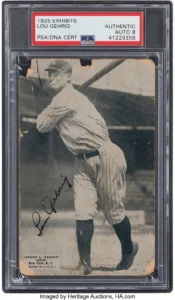
1925 Exhibits Lou Gehrig Rookie (PSA Authentic, Auto 8): Sold for $216,000 with only 4 PSA-authenticated autographed copies in existence.

1912 T202 Hassan Triple Folder Ty Cobb “Steals Third” (PSA Auto 9): Fetched $300,000 as the only PSA-authenticated autographed copy.

1933 Goudey Babe Ruth #144 (PSA 2, Auto 7): Sold for $585,600 with just 6 PSA-authenticated signed versions.
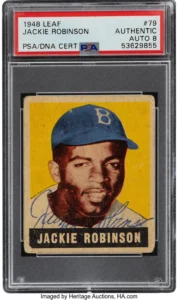
1948 Leaf Jackie Robinson Rookie #79 (PSA Authentic, Auto 8): Commanded $588,000 with only 3 PSA-authenticated autographed copies.

1952 Topps Mickey Mantle #311 (PSA 5.5, Auto 8): The crown jewel at $1,067,500 with 17 PSA-authenticated signed copies
Why the Lou Gehrig Card Stands Out Among the Legends
Look, it’s tough picking favorites when you’re dealing with the above cards, but that 1925 Exhibits Lou Gehrig rookie deserves some serious love. Only four PSA-authenticated autographed copies exist in the world. Four. You’ve got better odds doing plenty of other things in life than getting hands on one of these pieces of cardboard.
The Iron Horse doesn’t get the same spotlight as Ruth or Mantle in today’s memorabilia market, which honestly feels like a missed opportunity. When you’re holding a card he signed decades ago, you’re connecting with history in the rawest possible form.
What really grabs me is the authentication challenge. I mean, sheesh — this is a card that’s now over 100 years old. The type of verification technology we have now obviously didn’t exist back then. The fact that PSA authenticated only four copies speaks to how rare and how hard it is to confirm legit signatures from that era.
Breaking Down Lou Gehrig Card Values With and Without the Signature
Solow pointed something out in his article that perfectly illustrates the market dynamics when it comes to these cards. An unsigned 1925 Exhibits Lou Gehrig rookie graded PSA 6 MK sold for $782,400 in February 2021. Only 31 total copies achieved that PSA 6 grade, which is the highest grade this card has ever achieved.
Compare that to the signed version at $216,000. You’re saving over $500K, but you’re also getting something fundamentally different. The unsigned PSA 6 is one of 31 cards at that grade level. The authentic signed copy is one of four in the entire PSA population report.
It feels like that’s going to make the signed version worth more as collectors prioritize historical significance over numerical grades.
How Autographs Transform the Value Equation for Vintage Cards
This is where the conversation gets interesting. Traditional grading evaluates corners, edges, surface quality, and centering, all of which are subjective measurements made by third-party graders whose opinions can vary. That subjectivity gets thrown out the window with an autograph, though. A player either signed a card or he didn’t.
The market is starting to recognize this. An unsigned 1933 Goudey Babe Ruth #144 that sold for $1,065,000 has a PSA population of 1,378 graded cards. The signed version at $585,600 comes from just six PSA-authenticated copies. The unsigned card might be in better condition, but the signed version is rarer.
Signed vintage baseball cards are the ultimate combination of rarity, historical significance, and tangible connection to the players who built the game we love.
Love home runs? Sign up for my Substack today and start getting interesting home run-related observations straight to your inbox! And if you’re new to MLB Daily Dingers, it’s probably best to start here.